Which Natural Ingredient Is Best for Skin Brightening?
Date:August. 26 2026
share:
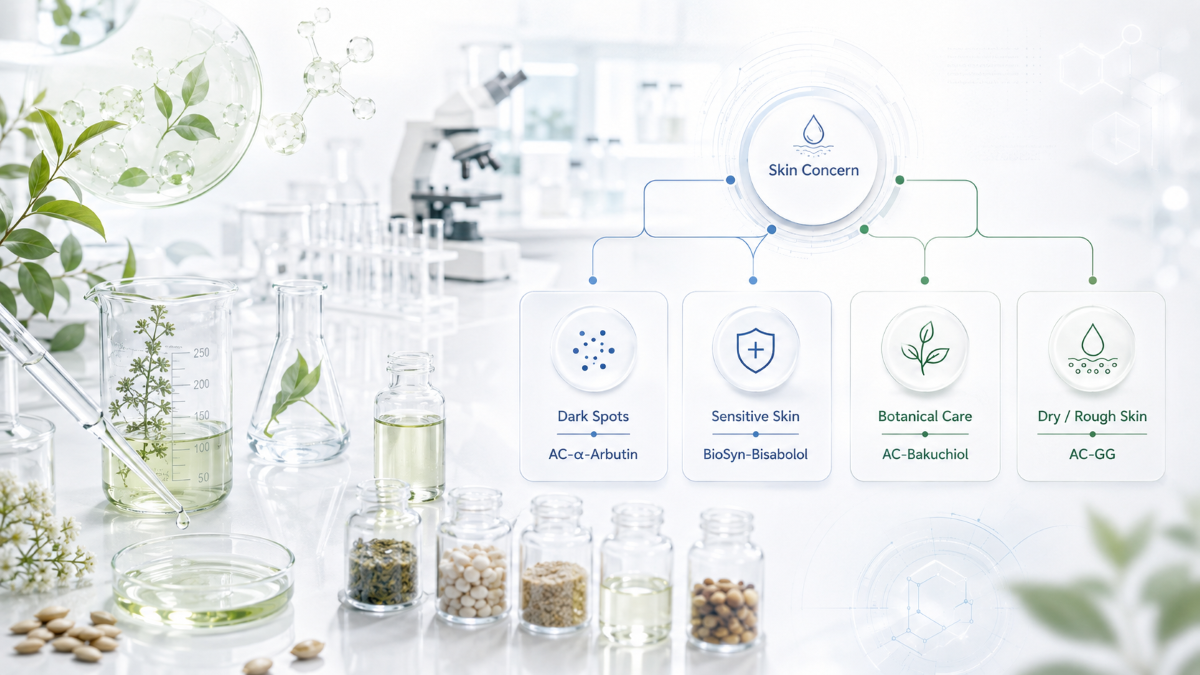
There is no single best answer unless “natural” is defined first. If the brief requires a strictly botanical ingredient, bakuchiol is the clearest choice. If natural-origin or enzyme-produced actives are acceptable, alpha-arbutin is often the preferred starting point for direct pigment-control support. For sensitive or inflammation-prone skin, bisabolol works best as a natural-origin calming co-active.
In this article, “natural” is used as a practical formulation term, not a universal regulatory category. We separate strictly plant-derived ingredients, fermentation-derived or enzyme-produced natural-origin actives, and chemically synthesized derivatives before choosing the best fit.
Quick Answer: Best Natural and Natural-Origin Brightening Ingredients by Goal
Goal
Best-Fit Ingredient
Source Positioning
Best Formula Fit
Main Limitation
Direct dark-spot support
Alpha-arbutin
Enzyme-produced, biotechnology-derived active
Water-based serums and lotions
Not directly extracted from a plant
Strict botanical positioning
Bakuchiol
Seed-derived plant extract
Oils, emulsions, day or night creams
Less direct pigment-control evidence
Sensitive or post-UV uneven tone
Bisabolol
Fermentation-derived active isomer
Soothing serums, creams and after-sun care
Better as a co-active than a stand-alone spot corrector
Rough, dull-looking skin
Glycolic acid
Naturally occurring AHA; commercial grade is chemically synthesized
Vitamin C derivatives, derived from natural sources
Oil-phase or water-phase systems
Must be described as derivatives
A formulator may choose bakuchiol for a botanical night cream, alpha-arbutin for a water-based dark-spot serum, and bisabolol for a post-UV sensitive-skin formula. The “best” ingredient changes when the claim, phase, pH and evidence requirement change.
What Does “Natural” Mean in a Skin-Brightening Ingredient?
In the U.S., the FDA has not defined “natural” for cosmetic labeling, and it also notes that a natural or organic source does not automatically guarantee safety. For that reason, origin claims and performance claims need to be evaluated separately.
Our technical team separates natural-positioning claims into three practical groups:
Category
What it means
Examples in this article
Claim boundary
Plant-extracted
The commercial ingredient comes directly from plant material.
Useful for brightening formulas, but outside a strict natural-ingredient ranking.
This distinction keeps a manufacturing-origin claim from being confused with a performance claim. To define the “best” ingredient, we look at source transparency, relevance to pigment formation, evidence type, skin-concern fit, and formulation compatibility.
Best Overall for Direct Pigment Control: Alpha-Arbutin
In our biocatalytic technology platform, AC-α-Arbutin is described as an enzyme-engineered hydroquinone glucoside with an α-glucosyl bond. Its value is not that it is plant-extracted, but that it gives formulators a controlled, water-compatible brightening active for tyrosinase-focused systems.
In formulation screening, we usually start with AC-α-Arbutin when the brief is a lightweight serum, lotion, sun-care booster or complexion formula targeting uneven tone. It is a better starting point when the formula can stay around pH 5-7, and the claim allows an enzyme-produced natural-origin active. If the brief requires a strictly botanical story, bakuchiol is a cleaner fit; if the main concern is irritation-linked discoloration, we would pair alpha-arbutin with a soothing co-active rather than rely on it alone.
For processing, AC-α-Arbutin is recommended to be pre-dispersed in glycerin or propylene glycol before water-phase addition. The finished system should stay around pH 5-7 and avoid strong acid or strong alkali conditions.
Supplier raw-material data and published mechanism research support alpha-arbutin’s role in tyrosinase-focused melanin control. These results describe ingredient-level or model-based performance, not guaranteed finished-product results.
Best Strictly Botanical Option: Bakuchiol
Bakuchiol is the better answer when the brief requires a direct plant source. Our raw-material documentation identifies AC-Bakuchiol as a high-purity, oil-soluble active derived from Psoralea corylifolia seeds, with Natural Origin Index = 1, supercritical CO₂ extraction, assay ≥99% by HPLC, psoralen + isopsoralen ≤25 ppm, ethanol residual solvent ≤50 ppm, and a recommended use level of 0.5%-1%.
It is oil-soluble and positioned for tone-evening, blemish care, antioxidant support and anti-aging rather than as a single-purpose dark-spot active. That broader profile fits formulas that combine tone care with early-aging, texture or blemish-related goals.
Formulation conditions are specific. For formulation screening, use 0.5%-1% in skincare formulas, add it to the oil phase, polyol or emulsifier phase, and manage light, heat, oxygen exposure and high-concentration metal ion contact during stability testing. The suggested formula pH is 6.5 or below, while strong acidic conditions and direct contact with high levels of metal ions should be avoided.
Independent peer-reviewed clinical research provides finished-formula context. In a randomized, double-blind, 12-week study of 44 participants, a 0.5% bakuchiol cream used twice daily and a 0.5% retinol cream used once daily both reduced wrinkle surface area and hyperpigmentation, while retinol users reported more scaling and stinging. This supports bakuchiol’s tone-evening and tolerability value, but it is not raw-material performance data for every formula.
Bakuchiol is most suitable for oil serums, creams, and botanical formulas that combine tone care with anti-aging or blemish-related goals. Alpha-arbutin remains the clearer starting point when the product brief focuses mainly on direct pigment control.
Best Natural-Origin Support for Sensitive Skin: Bisabolol
Uneven tone can be linked to irritation, acne marks, or UV stress. In these cases, selecting only a stronger pigment inhibitor may overlook the inflammatory environment around the discoloration.
BioSyn-Bisabolol is made by fermentation and provides a single active (-)-alpha-bisabolol configuration with 100% bio-based carbon content and a controlled impurity profile.
In cell-based inflammatory models, BioSyn-Bisabolol showed inhibition of inflammatory markers including IL-6, TNF-α, and nitric oxide under tested conditions. These results indicate potential soothing support but cannot be directly converted into human pigmentation improvement percentages.
Its brightening role is indirect but relevant. In our raw-material cell-model data, BioSyn-Bisabolol reduced intracellular cAMP levels and CREB phosphorylation in an α-MSH-induced model. This may reduce downstream signaling involved in melanin production.
In a post-blemish serum, bisabolol works better as the calming part of the system. It helps address the irritation side of uneven tone while a primary brightening active handles direct pigment-control positioning.
For sample screening, BioSyn-Bisabolol is typically used at 0.1%-1.0%, with a pH window of 3-9 and cool-down-stage addition below approximately 50°C. The wider pH window gives formulators more room across serums, creams and after-sun systems.
However, its reported penetration-enhancing effect means that the tolerance of the complete formula must still be tested rather than assumed from the mildness of one ingredient.
Supporting Ingredients and Their Natural-Origin Boundaries
Vitamin C derivatives are valuable when performance or stability matters more than a strict natural claim.
VcOS is a chemically synthesized, oil-soluble vitamin C derivative. VcOS is a chemically synthesized, oil-soluble vitamin C derivative with improved stability to heat and light. In vitro testing reported that 0.2% VcOS reduced melanin production by more than 80% in the tested model. The melanin index decreased from 220 to 183. We use this result as finished-formula application evidence, not as a universal claim for every VcOS formula.
The in vitro result and the human observation should not be presented as the same level of evidence.
AC-SAP is recommended for systems around pH 7.0 for optimal stability, with chelating agents such as EDTA-2Na considered to reduce degradation from trace metal ions.
For formulation planning, AC-SAP is used at 0.2%-2.0% in skincare, 0.2%-1.0% in sun-care products, and above 3.0% in lightening-positioned formulas. These conditions matter because being water-soluble does not mean an ingredient can be placed into every water-based brightening serum.
AHAs are naturally associated with sources such as fruits, yogurt and sugarcane, but AC-GLA itself is listed under Chemical Synthesis. It should therefore be treated as a naturally occurring AHA rather than a strictly natural ingredient.
Its main brightening contribution is exfoliation and epidermal renewal. This makes it more relevant to rough facial texture or body dullness than to a strict natural-active comparison.
Enzyme-produced ascorbyl palmitate can be discussed as an oil-soluble antioxidant support ingredient, but it should not be presented as the leading answer for targeted dark spots without stronger direct brightening evidence.
How to Choose by Skin Concern and Formula Type
Ingredient Selection Guide by Product Goal
Product Goal
Starting Ingredient
Why
Water-based brightening serum
AC-α-Arbutin
Water compatibility and direct pigment-control positioning
Botanical anti-aging cream
AC-Bakuchiol
Plant-origin positioning and tone-evening support
Sensitive skin brightening
BioSyn-Bisabolol + brightening active
Supports irritation-related uneven tone
Oil serum
AC-Bakuchiol / VcOS
Oil-phase compatibility
Body dullness care
AC-GLA / vitamin C derivatives
Exfoliation or antioxidant-focused approach
Formula pH can change the decision. Alpha-arbutin is best kept around pH 5–7, while AC-SAP is recommended around pH 7. We would not assume that they belong in one serum simply because both dissolve in water. A separate-product routine may be more stable than forcing both ingredients into a compromised pH.
Low-pH exfoliating products are a more natural home for glycolic acid, with bisabolol considered for soothing support. A natural active also does not make the whole product natural. Solvents, emulsifiers, preservatives, chelators, fragrance and packaging all affect final stability and claim suitability.
Can Natural-Origin Brightening Ingredients Be Combined?
Yes, but the formula should assign each ingredient a clear job. Start with one main pigment-control active, add a calming co-active when inflammation matters, and then support hydration and barrier function.
Consider a sensitive-skin serum designed for post-UV uneven tone. We would begin with alpha-arbutin as the main water-phase active, keep the system within its pH range, and add bisabolol through a suitable solubilizing or emulsion route.
AC-SAP should be evaluated before being added because its preferred pH is different from the main working range given for alpha-arbutin.
What Formulators Should Verify Before Making a Brightening Claim
First, identify the type of evidence. A human clinical study, reconstructed-skin model, cell study, enzyme assay, and supplier position do not carry equal weight.
Second, separate raw-material performance from finished-product performance. Concentration, pH, solubility, emulsification, oxidation, packaging and interactions with other ingredients can all change the outcome.
Before selecting an ingredient, we review the latest TDS, SDS and COA, along with the assay method, residual solvent limits, heavy-metal limits, recommended temperature and pH.
Claims should remain within responsible cosmetic language:
supports a more even-looking tone;
helps reduce the appearance of dark spots;
supports radiance;
helps calm irritation-linked uneven tone.
Phrases such as “permanently whitens skin,” “removes melasma,” or “guaranteed whitening” do not reflect responsible cosmetic claims or the limits of ingredient-level evidence.
FAQs About Natural Skin-Brightening Ingredients
Is alpha-arbutin natural?
It is more accurate to call it enzyme-produced or biotechnology-derived. It is not a direct botanical extract, and any natural-origin claim should be checked against current sourcing documents and the applicable market standard.
Is bakuchiol better than alpha-arbutin?
Bakuchiol is better for a strictly botanical, oil-soluble and multi-benefit formula. Alpha-arbutin has the clearer role when direct pigment-control support is the main goal. They are not direct substitutes because their formulation properties and primary roles differ.
Which option is best for sensitive skin?
Bisabolol is the strongest support choice when uneven tone is linked to irritation, blemishes or UV stress. It usually works best beside a primary brightening active rather than replacing one.
Are vitamin C derivatives natural?
Not automatically. VcOS and AC-SAP are currently classified as chemically synthesized derivatives. The manufacturing route and supporting documents matter more than the fact that these ingredients are related to vitamin C.
Can natural brightening ingredients be used together?
Yes. Combine them by mechanism, pH, solubility and tolerance instead of stacking as many actives as possible. Each combination still needs compatibility, stability and finished-product efficacy testing.
Conclusion
The best natural or natural-origin brightening ingredient depends on how the brand defines “natural,” what skin concern the formula targets, and what technical documents support the claim.
If you are developing a natural-origin brightening serum, botanical tone-evening cream, sensitive-skin dark spot product or body brightening formula, start with the formula brief rather than the ingredient list. Send our technical team the target claim, product format, pH range, skin concern, preferred natural-positioning standard, and required document package. We can help compare suitable brightening actives, screen compatibility limits, and identify the TDS, SDS, COA, and specification files needed before formulation testing.
By clicking "Accept," you agree to the storing of cookies on your device to enhance site navigation, analyze site usage, and assist in our marketing efforts.