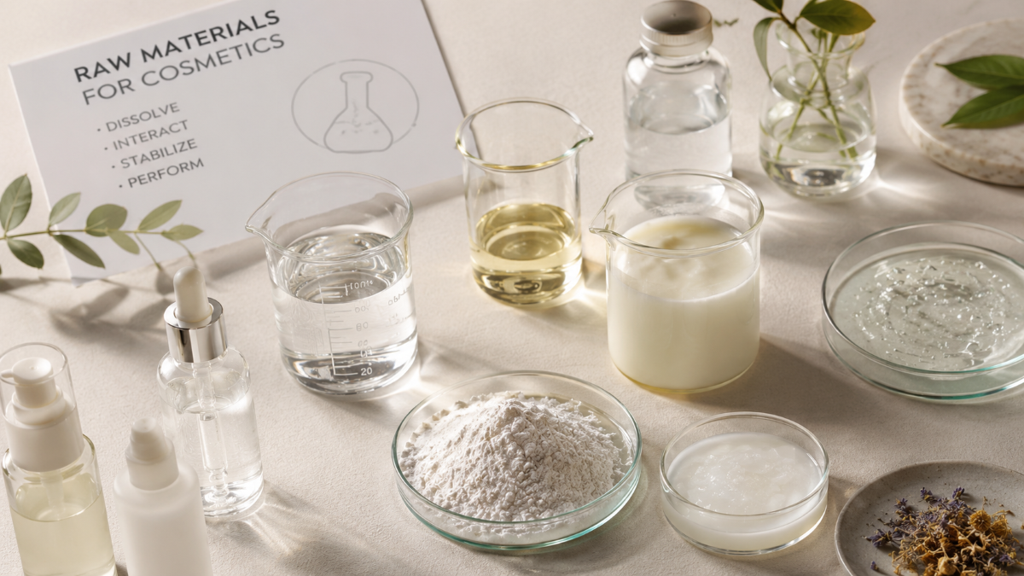
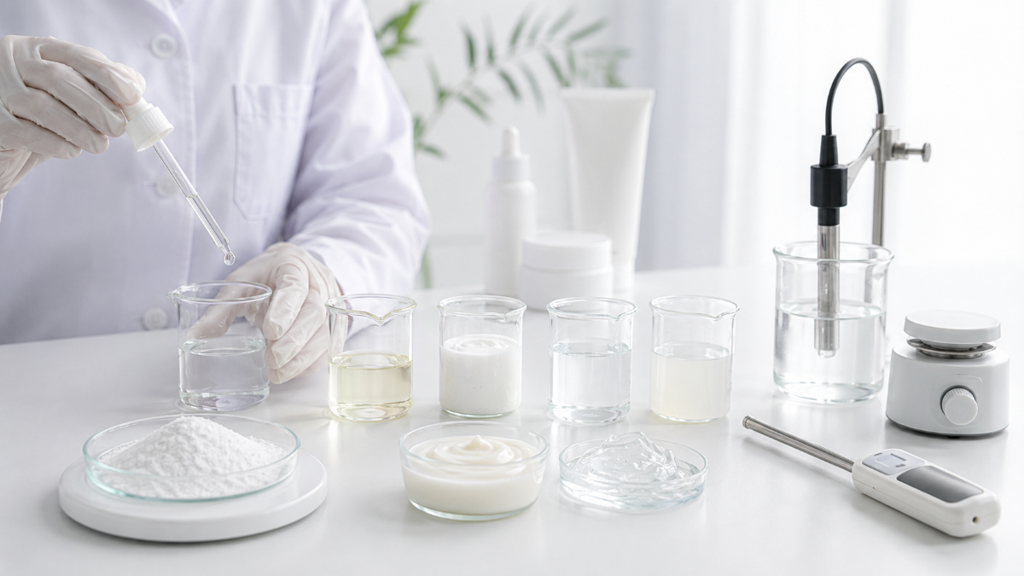
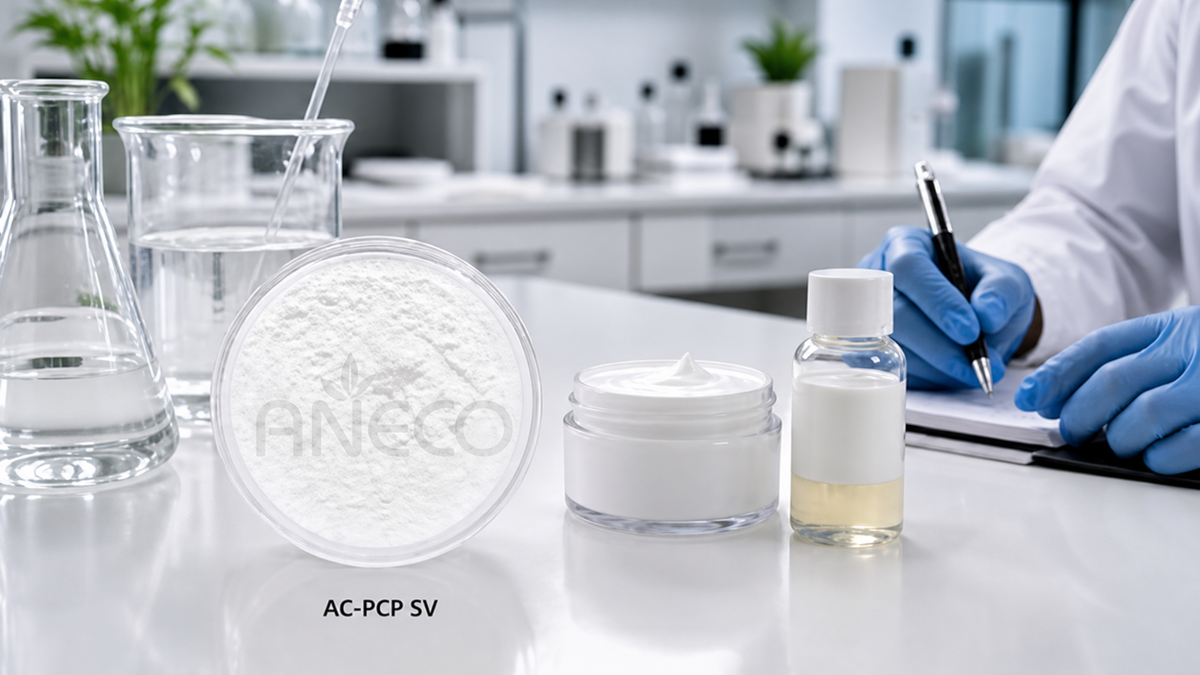
Cosmetic raw materials are the ingredients and commercial grades used to build a finished beauty product. They include carriers, emollients, humectants, surfactants, emulsifiers, thickeners, active ingredients, preservation aids, and sensory materials. At ANECO, we look at raw materials for beauty products through real formulation work: how they dissolve, interact, stabilize, and perform across product formats.
A viable raw material has to dissolve or disperse in the intended system, survive the manufacturing process, and remain compatible with the complete formula. Even a well-supported active fails the brief when it crystallizes, destabilizes an emulsion, or cannot be processed consistently.
What Counts as a Cosmetic Raw Material?
Cosmetic Raw Material vs. INCI Ingredient
An INCI name is the standardized identity shown on a cosmetic label. A commercial raw material is the grade supplied to the formulator — it may be a pure substance, diluted active, solution, dispersion, or premixed complex.
“2% raw material” and “2% active ingredient” can therefore describe very different concentrations. The specification should state active content, carrier, INCI composition, and quality limits.
Why the Same Ingredient Name May Behave Differently
Grades built around the same ingredient can vary in solubility, concentration, particle size, impurities, carrier, and processing window. One may suit an anhydrous balm; another may fit a clear serum. Selection begins with the job inside the formula and the conditions during manufacturing and storage.
The Main Types of Raw Materials for Beauty Products
A complete formula draws from several material groups. Each example below represents an ingredient role, not a complete recipe.
Raw-material group
Main role
Common examples
Relevant portfolio examples
Solvents and carriers
Dissolve, disperse, or carry ingredients
Water, ethanol, glycols, DMI
AC-DMI
Emollients and occlusives
Improve glide and moisture retention
Squalane, esters, oils, silicones
BioSyn-Squalane
Humectants and barrier materials
Attract water or support barrier lipids
Glycerin, Sodium Hyaluronate, ceramides
AC-HA, Ceramide Series
Surfactants and refatting agents
Cleanse, wet, foam, or improve after-feel
Glucosides, betaines, lipid additives
APG, AC-PO65
Emulsifiers and solubilizers
Keep oil and water dispersed
Nonionic and anionic O/W emulsifiers
AC-M68 SV, AC-PCP SV
Rheology modifiers
Control flow, clarity, and suspension
Carbomer, acrylate crosspolymers
Carbomer Series
Active ingredients
Support a defined skin or hair benefit
Vitamin C derivatives, retinoids, bakuchiol
AC-VCE, AC-SAP, HPR Series, AC-Bakuchiol, AC-TA
Preservation and stability aids
Manage microbes, oxidation, metals, and pH
Preservatives, antioxidants, chelators
Selected as a complete system
Sensory materials
Shape color, scent, or feel
Pigments, fragrance, warming agents
AC-VBE
How Raw Materials Work Together in a Cosmetic Formula
The Base Layer: Carriers, Emollients, and Humectants
AC-DMI (Dimethyl Isosorbide) can be screened as a co-solvent to improve the solubility of difficult oil-soluble actives, but the final use level and clarity still need confirmation in the full formula.
BioSyn-Squalane is a sugar-derived, fermentation-produced emollient (assay ≥98%) whose light finish suits facial oils and emulsion oil phases where heavier esters leave a film.
AC-HA offers Sodium Hyaluronate from 10 kDa to 2.5 MDa. Higher weights build surface hydration and film feel; lower weights improve penetration but add less texture body. Blending two ranges balances both. Ceramide grades take a separate barrier-lipid approach.
The Structure Layer: Surfactants, Emulsifiers, and Rheology Modifiers
Surfactants remove oils, emulsifiers organize oil-and-water systems, and rheology modifiers control flow. Getting these wrong usually surfaces as separation or viscosity drift — often at scale-up rather than at bench.
AC-PO65, with the INCI Coco-Glucoside and Glyceryl Oleate, has a recommended screening range of 1%–5%. It contributes to foam stability, viscosity, oil dispersion, and a moisturized post-rinse feel, so the grade should be assessed with the primary and secondary surfactants already in place. In our screening, we adjust the surfactant ratio against foam, viscosity, mildness, and after-feel together; increasing total surfactant load alone can move all four variables.
Emulsifier capacity varies with oil load. AC-M68 SV reports 0.5% emulsifying 30% oil; AC-PCP SV reports 1% emulsifying up to 80%. If a prototype separates, switching to an emulsifier designed for a higher oil ratio often works better than increasing the dosage of the original grade.
For rheology, blending long-rheology AC-Carbomer U20 with short-rheology AC-Carbomer U21 builds body and electrolyte tolerance while keeping skin feel light.
The Performance Layer: Actives, Antioxidants, and Sensory Materials
Heat-sensitive actives — HPR, AC-Bakuchiol , vitamin C derivatives — should enter at cool-down below 45 °C, after emulsification. Adding them during the hot phase risks degradation. If discoloration appears in a VcOS formula despite its inherent stability, checking for trace metal ions or pH drift is more productive than increasing antioxidant load.
AC-VBE is an oil-soluble Vanillyl Butyl Ether grade with a 0.05%–0.5% formulation-trial range and an approximate warming onset of two minutes. The perceived warmth varies with dosage, vehicle, and test conditions. Oil-rich systems buffer the effect; water-gel bases sharpen it.
Choosing Raw Materials by Beauty Product Format
The product brief narrows the options before laboratory work begins. These are screening directions. UV filters, preservatives, chelators, packaging, and market-specific rules need separate review.
Finished format
Main formulation focus
Suitable examples for screening
Water-based serum
Water compatibility, hydration, clear rheology
AC-HA, AC-HPR-W2 SACOS, AC-Carbomer U21
Cream or lotion
Emulsification, emollience, viscosity
BioSyn-Squalane, AC-M68 SV, AC-PCP SV, Ceramide Series
Emulsion strength and pigment or filter dispersion
AC-M68 SV, AC-PCP SV, VcOS
How Do Formulators Choose the Right Cosmetic Raw Material?
Start With the Finished Product
A clear serum cannot hide crystals; a pump lotion needs controlled flow. In formulation screening, mismatches often trace back to choosing an active before locking three parameters: product format, sensory target, and delivery method. Fixing these first eliminates more unsuitable options than any database search.
Identify Phase and Solubility
Water-soluble, oil-soluble, and water-dispersible describe different behaviors. When an oil-soluble active must enter a water-based serum, the options include pre-dissolving in a co-solvent (AC-DMI), switching to a water-dispersible grade (AC-HPR-W2 SACOS), or building an emulsion system. Each route changes clarity, concentration, and stability. Early haze or precipitation often points to a mismatch among the commercial grade, carrier load, and phase composition. The active may remain chemically intact while losing physical compatibility, so clarity alone should not be treated as a complete stability result.
Define pH and Processing Conditions
pH shifts after each addition, not just at the end. Carbomer viscosity drops sharply outside pH 5–9, so a formula that drifts after fragrance or active addition loses body. Measuring pH after every step catches drift early. Cool-down addition below 45 °C protects sensitive actives like HPR. Supplier guidance sets the starting range; in-formula testing confirms the working window.
Check Compatibility and Interactions
Salts, metal ions, ionic surfactants, and cationic materials can change clarity or viscosity. At 0.2%, Carbomer self-wetting times range from about 60 minutes (AC-Carbomer 940) to 1.5 minutes (AC-Carbomer U21). If a batch hydrates too slowly, switching to U20 or U21 compresses the process without changing the viscosity target. Running a compatibility matrix — active × emulsifier × preservative × thickener — before pilot confirms the system holds.
Why the Same Active Ingredient May Need a Different Grade
HPR for Oil-Based, Solvent-Based, and Water-Compatible Systems
Once the formula phase and active target are fixed, the commercial form becomes the next decision. Hydroxypinacolone Retinoate is a useful example because the same headline active is supplied as a high-purity oil-soluble powder, a DMI solution, and water-soluble commercial formats.
Grade
Official product form
Formulation use
AC-HPR
Oil-soluble powder, HPLC purity ≥99%
Systems where the formulator controls oil-phase solubilization
AC-HPR-S10
10% HPR in Dimethyl Isosorbide
Projects favoring a pre-solubilized liquid
AC-HPR-W2 SACOS
Water-compatible grade with 2.0% ± 0.2% HPR
Water-based or low-oil systems
AC-HPR-W2 SACOS PRO
Water-compatible HPR with 0.2% Glucosylrutin
Concepts seeking antioxidant support
In aqueous screening, AC-HPR-W2 SACOS was tested at 1%–10% raw-material solution levels and stored at room temperature for 21 days, with no precipitation observed under those conditions. The result supports initial grade selection for water-based concepts; a finished serum still requires compatibility, light, oxygen, packaging, and long-term stability testing.
Ceramide Raw Materials: Single Lipid, Delivery System, or Complex
The Ceramide Series includes AC-Ceramide NP, AC-Ceramide NP SANIO, AC-Ceramide FLUX 136, and AC-Ceramide SANIO 1236. Their formats raise different questions around dispersion, crystallization, lipid balance, and processing.
AC-Ceramide FLUX 136 combines Ceramides NP, AP, and EOP with cholesterol and phytosphingosine in an approximately 3:1:1 ratio. Our laboratory thermal test recorded no phase separation or degradation after 12 weeks at temperatures up to 45°C. That result applies to the tested multilamellar system; it does not establish the shelf life of a customer’s finished cream. In selection terms, the pre-dispersed complex reduces part of the work involved in building a multi-lipid phase, whereas AC-Ceramide NP gives the formulator more control over lipid ratio and oil-phase processing.
Does the Manufacturing Route Change the Raw Material?
Precision Fermentation
The production route can influence molecular form, impurity profile, source consistency, and supply reliability. BioSyn-Squalane is sugar-derived and produced through bio-fermentation. BioSyn-Bisabolol is fermentation-derived (-)-alpha-bisabolol with an assay of at least 95% and a single active configuration.
These specifications provide a clearer basis for formulation review than a broad “natural” label.
Bioenzymatic Modification
AC-α-Arbutin is an enzyme-produced Alpha-Arbutin grade with content above 99%. AC-GR is a glycosylated rutin derivative developed to address poor water solubility and instability. Practical review still centers on identity, solubility, impurities, and batch control.
Chemical Synthesis and Delivery Systems
Chemical synthesis provides defined structures and controlled specifications. Delivery systems address dispersion, crystallization, or active protection. AC-HPR-W2 SACOS and AC-Ceramide NP SANIO show how commercial form expands possible product formats.
What Should R&D and Procurement Teams Verify Before Approving a Raw Material?
Verification item
Why it matters
Exact INCI and grade
Reveals different carriers or concentrations
Active content or assay
Links dosage to the true active level
TDS, SDS, COA, and specification
Supports formulation, safety, quality, and purchasing
Solubility and phase
Guides incorporation and equipment choices
pH and temperature guidance
Sets initial laboratory conditions
Storage and shelf life
Affects stability and supply planning
Charge and electrolyte compatibility
May change clarity, viscosity, or emulsion stability
Impurity and microbial limits
Supports quality and market review
Regulatory status
Permitted use and claims vary by market
MOQ, lead time, and batch consistency
Determines commercial feasibility
A Practical Raw-Material Approval Flow
Before approving a raw material for pilot work or purchase, R&D and procurement teams can move through five checks:
Screen the exact commercial grade.<br>Confirm the INCI name, active content, carrier system, specification limits, and whether the grade matches the intended product format.
Request the current sample and documents.<br>Review the TDS, SDS, COA, specification, storage guidance, shelf-life information, and available regulatory statements for the exact batch or grade.
Check formulation fit on the bench.<br>Test solubility, phase compatibility, pH range, temperature window, electrolyte tolerance, and interactions with surfactants, emulsifiers, preservatives, and thickeners.
Run pilot stability and packaging checks.<br>A promising lab result should be confirmed in the full formula, with the intended process, packaging, storage conditions, and target market requirements.
Complete regulatory and purchasing sign-off.<br>Confirm permitted use, label composition, claim support, impurity limits, MOQ, lead time, batch consistency, and long-term supply feasibility before bulk approval.
Raw Material Selection Red Flags Before Scale-Up
Before scale-up or purchase approval, the formula should have a defined format, selected commercial grade, and initial lab results. At ANECO, we treat the following signals as reasons to pause before pilot batching, claim development, or bulk purchasing.
The Product Format Is Still Undefined
Risk signal: The active has been selected before the continuous phase, target appearance, sensory profile, packaging, and leave-on or rinse-off use are fixed.
Consequence: The selected grade may not fit the vehicle. For example, AC-HPR, AC-HPR-S10, and AC-HPR-W2 SACOS all involve HPR, but they fit different solubility and carrier requirements.
Immediate action: Lock the product format first. Define whether the formula is a clear aqueous serum, emulsion, anhydrous balm, cleanser, sunscreen, or color cosmetic before selecting the commercial grade.
The Active Level Has Not Been Calculated
Risk signal: The team records only the raw-material addition level, not the true active concentration.
Consequence: A 2% addition of AC-HPR-W2 SACOS contributes about 0.04% HPR, based on its 2.0% ± 0.2% HPR range. That is not equivalent to adding 2% high-purity AC-HPR.
Immediate action: Calculate active concentration from the assay or COA before safety review, cost analysis, batch instruction, efficacy testing, or claim planning.
The Material Looks Compatible on Paper Only
Risk signal: The grade appears suitable based on the TDS, but has not been tested in the complete formula.
Consequence: Solubility, viscosity, clarity, suspension, salt tolerance, and skin feel may change once the material meets the real electrolyte load, surfactants, oils, preservative system, shear, cooling profile, and packaging.
Immediate action: Run bench compatibility checks before scale-up. For rheology systems, compare wetting time, clarity, electrolyte tolerance, and final texture instead of selecting by one parameter alone.
Supplier Screening Data Is Used as a Finished-Product Claim
Risk signal: Raw-material screening data is being used as if it proves finished-product performance.
Consequence: Data such as AC-HPR-W2 SACOS showing no precipitation in 1%–10% aqueous raw-material solutions for 21 days, or AC-Ceramide FLUX 136 stability under stated conditions, supports grade selection only. It does not prove finished serum or cream stability.
Immediate action: Use supplier screening data to choose candidates, then confirm finished-product stability, packaging compatibility, safety, and claim substantiation separately.
Regulatory and Market Review Comes Too Late
Risk signal: The team confirms regulatory status only after the formula and purchasing decision are nearly complete.
Consequence: Commercial grades built around the same active may have different declared compositions. AC-HPR and AC-HPR-S10 affect ingredient listing, active-level calculation, dossier preparation, and market review differently.
Immediate action: Confirm exact grade, INCI composition, intended use level, product category, label requirements, supporting documents, and proposed claims before purchase approval.
Frequently Asked Questions
What are the most common raw materials used in cosmetics?
Common groups include carriers, emollients, humectants, surfactants, emulsifiers, thickeners, active ingredients, preservation aids, chelators, antioxidants, colorants, fragrances, and sensory materials. The raw-material group table earlier in the article breaks these roles down by function and product examples.
What is the difference between an active ingredient and a functional ingredient?
An active supports a targeted skin or hair benefit, while a functional ingredient helps the product cleanse, emulsify, thicken, remain stable, or feel pleasant. Some materials serve both roles, which is why the finished product format should guide selection before the ingredient list is finalized.
Are natural raw materials always better for beauty products?
No. Natural origin alone does not prove better safety, stability, performance, or supply reliability. The manufacturing-route section above shows why plant, fermentation, and synthetic routes should be compared by purity, impurity profile, documentation, and formulation fit.
How do formulators choose between water-soluble and oil-soluble actives?
They start with the continuous phase, product format, clarity target, process, and stability needs. The product-format table above shows why water-compatible forms may suit some serums, while oil-soluble grades are better suited to balms or oil phases.
Can the same cosmetic raw material be used in every product?
Rarely. One INCI may be sold as a powder, solution, dispersion, or complex with different active levels, and pH, salts, temperature, and packaging can change compatibility. The HPR grade comparison illustrates how one active may need different commercial forms for different systems.
What documents should a cosmetic raw-material supplier provide?
A supplier should provide the TDS, SDS, COA, specification, and relevant regulatory or origin documents. The approval checklist earlier in the article outlines the documents used in formulation, quality, purchasing, and market review.
Conclusion: Choose the Formula System, Not Just the Ingredient
A reliable beauty product comes from a coordinated system. Base materials establish the medium and sensory profile, structural ingredients support physical stability, actives support the intended benefit, and the preservation system protects the product through its usable life.
Ingredient popularity offers little guidance without the right grade, phase, pH, process, and evidence. Developing a serum, cream, cleanser, sunscreen, or other personal-care product? Share your target format, key benefit, and intended market with our technical team to request suitable raw-material options, samples, and product-specific documents.
By clicking "Accept," you agree to the storing of cookies on your device to enhance site navigation, analyze site usage, and assist in our marketing efforts.