What Is a Mild Surfactant? Types, Benefits, and How to Choose the Right One
Date:August. 18 2026
share:
A mild surfactant is a cleansing ingredient designed to remove oil, dirt, and impurities while reducing the risk of dryness, tightness, or excessive degreasing. In our formulation work, we do not define “mild” as “weak.” A good mild surfactant still needs to clean effectively, foam properly, rinse well, and stay compatible with the rest of the formula.
The real challenge is balance. A facial cleanser, baby shampoo, body wash, dishwashing liquid, and hard surface cleaner all need different levels of cleansing power. That is why we start with the application first: skin-contact frequency, foam target, oil load, water hardness, pH, and after-feel all affect the right surfactant choice.
What Is a Mild Surfactant?
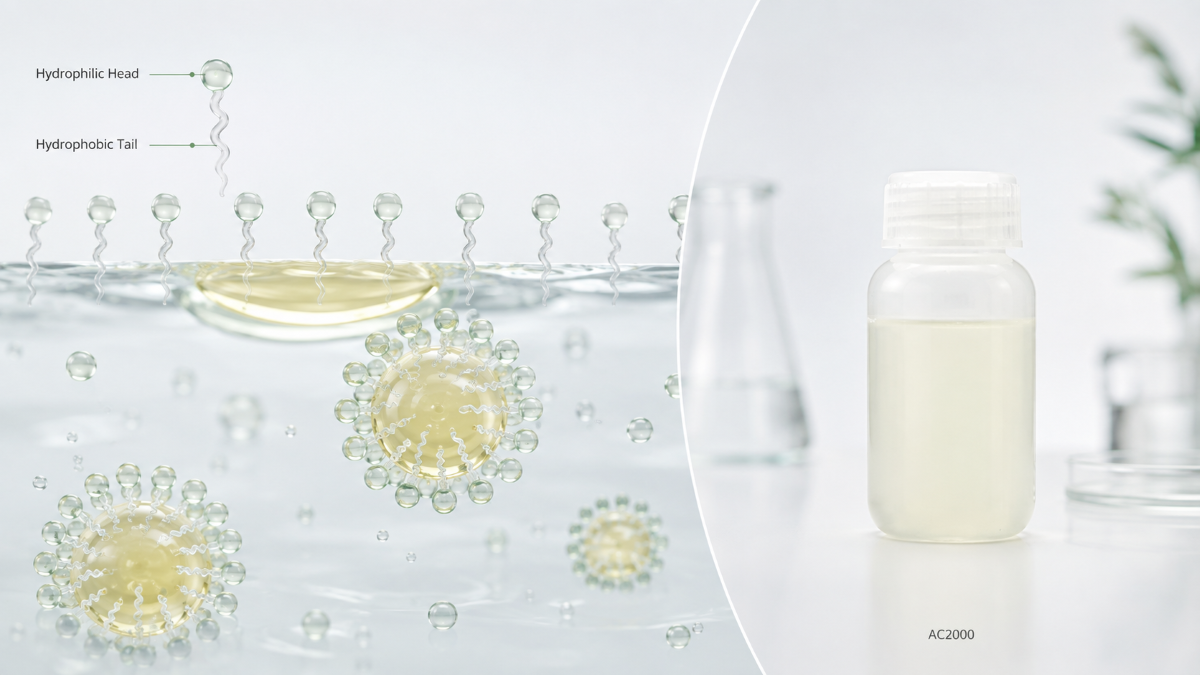
A surfactant is a molecule with two functional parts: a water-loving hydrophilic head and an oil-loving hydrophobic tail. During cleansing, the oil-loving part helps attach to sebum, grease, or oily dirt, while the water-loving part helps disperse those soils into water so they can be rinsed away.
A mild surfactant does this without relying on overly aggressive stripping. Traditional strong anionic surfactants such as SLS or SLES can provide excellent foam and cleaning, but in some formulas they may create a dry or tight after-feel because they remove too much surface lipid. This does not mean they are always “bad.” It means formulators must manage their concentration, combinations, and final system carefully.
Alkyl Polyglucoside, or APG, is a useful example of how structure affects mildness. APG contains a glucose-derived hydrophilic glycoside group and a fatty-alcohol-derived hydrophobic alkyl chain. APG structures are commonly described by their degree of polymerization (DP), which varies depending on the product grade and alkyl chain composition. This sugar-based, nonionic structure helps explain why APG can combine mildness, cleansing, compatibility, and biodegradability in one ingredient family.
Common Types of Mild Surfactants
The most common mild surfactant families include sugar-based nonionic surfactants, amphoteric co-surfactants, amino-acid surfactants, and refatting surfactant blends.
Sugar-based nonionic surfactants include APG ingredients such as Decyl Glucoside, Lauryl Glucoside, Coco-Glucoside, and Caprylyl/Capryl Glucoside. These are often selected for sulfate-free cleansing, sensitive-skin concepts, home care, and industrial cleaners that need both cleaning and lower irritation potential.
Amphoteric surfactants, such as betaine-type ingredients, are often used with anionic or nonionic systems to improve foam quality and reduce harshness. In APG systems, they can help tune foam stability and sensory feel.
Amino-acid surfactants can also be used in mild facial cleansers. We do not treat them as interchangeable with APG: their foam, viscosity, pH behavior, and cost profile are different.
Refatting blends are another important category. AC-PO65, for example, uses the INCI name Coco-Glucoside (and) Glyceryl Oleate. In surfactant cleansing preparations, it is positioned to support mild cleansing, foam stability, viscosity contribution, oil dispersion, and moisturized after-feel.
Why Structure Matters in Mild Cleansing
In mild cleansing, the ingredient name is only the starting point. The same surfactant family can feel different when chain length, active level, pH, co-surfactants, salt, thickener system, fragrance, and preservative choices change. We look at the whole system because the user's skin does not experience a single raw material; it experiences the finished formula.
APG shows this clearly. Its hydrophilic glycoside group comes from glucose, while its hydrophobic alkyl chain comes from fatty alcohols. During cleansing, the alkyl chain helps attach to sebum, grease, and oily dirt, while the sugar-based head helps carry those soils into water.
In practice, the choice depends on what the formula needs most. If fast wetting and spreading are the priority, C8-10 APG grades are a logical starting point. If richer foam, sebum removal, or viscosity support is more important, C12-14 grades such as Lauryl Glucoside may fit better. If the formula also needs a softer post-rinse feel, a refatting component such as AC-PO65 can be evaluated within the complete surfactant system.
Our APG materials describe biodegradability as exceeding 98%, with more than 70% degradation achieved within 28 days in the stated OECD 301D context. These figures describe APG under stated test conditions; they should not be stretched into a claim that every finished cleanser has the same environmental profile.
Mildness should also be stated precisely. Our APG information references OECD Test Guideline 404 evaluation, supporting APG’s favorable skin compatibility profile under tested conditions. That supports APG’s role in mild cleansing systems, but it does not mean APG alone makes a formula mild.
How to Choose a Mild Surfactant for Different Applications
We usually start with the product scenario, then choose the surfactant system.
Application
Main Requirement
Suitable Direction
Facial cleanser
Low irritation, mild sebum removal, clean rinse
Decyl Glucoside for mild skin cleansing; C8-10 APG for fast wetting; Lauryl Glucoside when richer foam or stronger oil removal is needed
Baby care cleanser
Mildness, low tightness, soft after-feel
APG-based sulfate-free system; AC-PO65 when refatting and post-rinse comfort are part of the target
Shampoo
Foam, cleansing, viscosity, scalp comfort
C12-14 APG such as Lauryl Glucoside for richer foam and oil/sebum removal; AC-PO65 can support viscosity, foam stability, and after-feel
Body wash
Creamy foam, mild cleansing, moisturized feel
Coco-Glucoside or Decyl Glucoside system; AC-PO65 when foam stability, oil dispersion, and moisturized after-feel are needed
Hand dishwashing
Oil removal, hand mildness, hot/hard water tolerance
Lauryl Glucoside or Decyl Glucoside, with formulation support from chelants if needed
Hard surface cleaning
Wetting, anti-redeposition, easy rinsing
Caprylyl/Capryl Glucoside grades such as AC8170N or AC0810 50%
Here is how this works in a rinse-off product. If we are developing a sulfate-free body wash for a dry or sensitive-feel position, we would not simply reduce the surfactant level until the formula feels mild. That can weaken cleansing and foam. A better route is to build an APG-based system that supports viscosity, oil dispersion, and a moisturized after-feel. In this kind of formula, AC-PO65 can be evaluated within its recommended 1-5% use range when the target includes foam stability, viscosity contribution, oil dispersion, and a moisturized after-feel. Its specification gives 64.0-68.0% solid content, pH 3.0-4.0 in 5% aqueous solution, and density of 1.06-1.10 g/ml at 20°C.
For buyers, selection is not only a laboratory question. Supply consistency and documentation also matter once a formula moves toward sampling, qualification, and scale-up. Our Yangzhou production base primarily manufactures mild surfactant products and lists an annual surfactant production capacity of 60,000 tonnes. This does not prove that one surfactant is milder than another, but it does matter when a team needs stable supply and supporting documents such as TDS, MSDS, and COA during purchasing review.
Frequently Asked Questions
Is APG a mild surfactant?
Yes. APG is widely used as a mild nonionic surfactant family. Its glucose-derived head group, fatty alcohol-derived alkyl chain, nonionic structure, and biodegradability profile make it suitable for mild cleansing systems. Still, the final mildness depends on the full formula.
Is mild surfactant suitable for sensitive skin?
It can be, but not by default. Sensitive-skin formulas still need suitable pH, surfactant level, fragrance, preservatives, refatting agents, and finished-product irritation testing.
Does mild surfactant mean weak cleansing?
No. A mild surfactant should clean efficiently while reducing unnecessary harshness. APG is a good example because different chain lengths can be selected for wetting, foaming, oil removal, or hard surface cleaning.
Which APG surfactant is best for facial cleanser?
There is no single best option. Decyl Glucoside is suitable for mild skin cleansing. C8-10 APG such as Caprylyl/Capryl Glucoside helps with fast wetting and transparent systems. C12-14 APG such as Lauryl Glucoside is useful when richer foam, sebum removal, or viscosity support is needed.
Conclusion
A mild surfactant is not the mildest ingredient on paper. It is the surfactant system that delivers the right balance of cleansing power, foam, rinse feel, skin comfort, stability, and environmental profile for a specific application.
In practice, chain length, co-surfactant choice, oil load, water hardness, pH, and after-feel all matter. We choose the surfactant system only after the application target is clear, then confirm the result through complete-formula testing rather than relying on an ingredient name alone.
By clicking "Accept," you agree to the storing of cookies on your device to enhance site navigation, analyze site usage, and assist in our marketing efforts.