



 Request a Sample
Amphiphilic Structure
The ethyl ether structure provides both water- and oil-phase compatibility for flexible cosmetic formula design.


Stable Vitamin C Derivative
INCI name: 3-O-Ethyl Ascorbic Acid
CAS No. 86404-04-8
AMPHIPHILIC VITAMIN C DERIVATIVE FOR MODERN SKINCARE
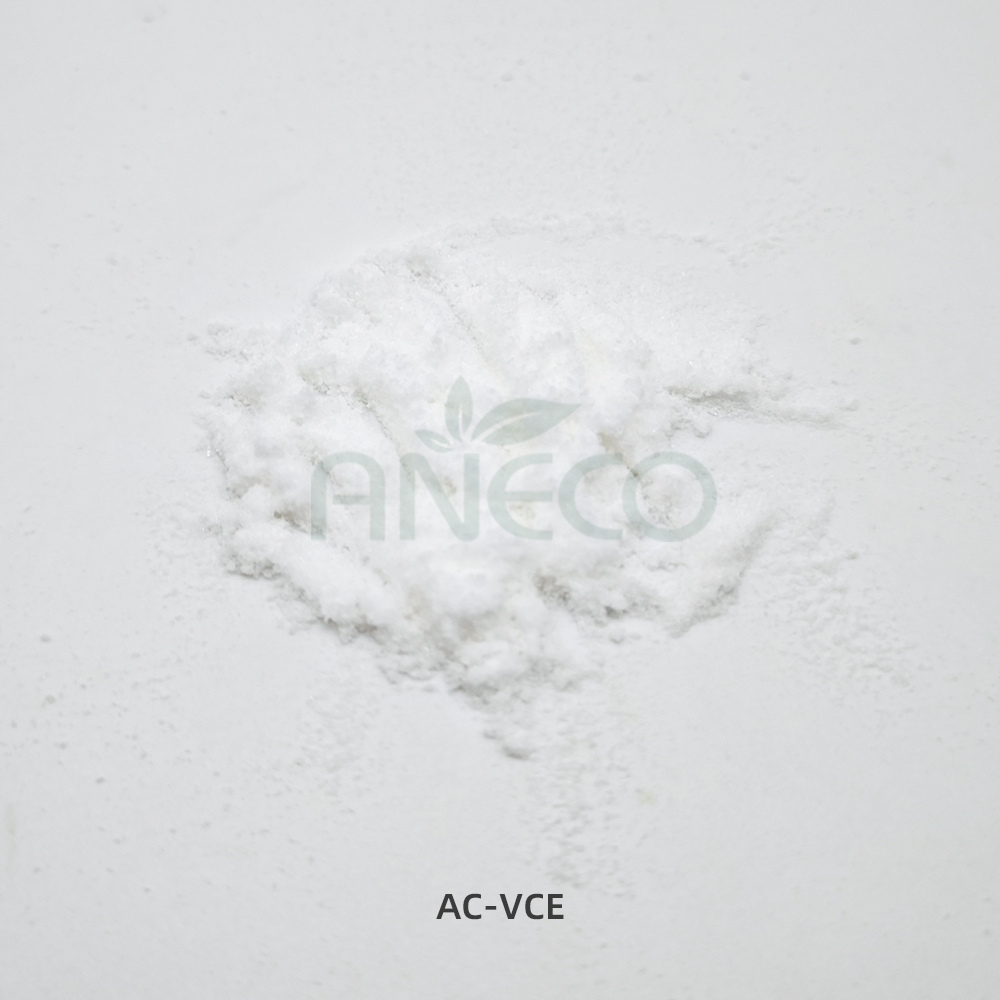
AC-VCE is ANECO 3-O-Ethyl Ascorbic Acid, an amphiphilic vitamin C derivative for brightening and antioxidant skincare formulas. It contains at least 98% 3-O-Ethyl Ascorbic Acid by HPLC and provides solution-stability, tyrosinase-inhibition and DPPH radical-scavenging performance under defined test conditions.
Product Identity
Review identity, assay, moisture, pH and melting range before selecting AC-VCE for formulation trials.
| Product Name | AC-VCE | INCI Name | 3-O-Ethyl Ascorbic Acid |
|---|---|---|---|
| Synonym | L-Ascorbic acid, 3-O-Ethyl Ether | CAS No. | 86404-04-8 |
| EC / EINECS No. | 617-849-3 | Molecular Formula | C8H12O6 |
| Molecular Weight | 204.18 g/mol | Appearance | White to off-white crystalline powder |
| Assay by HPLC | ≥98.0% | Moisture | ≤2.0% |
| pH (3% aq.) | 3.0-6.0 | Melting Point | 111.0-116.0°C |
The ethyl ether structure provides both water- and oil-phase compatibility for flexible cosmetic formula design.
Assay, moisture, pH, melting point and heavy-metal limits provide defined quality controls.
For emulsions, dissolve AC-VCE in water and add the solution after the system cools below 45°C.
Stability and Test Context
AC-VCE combines at least 98% HPLC assay with solution-stability, DPPH radical-scavenging and tyrosinase-inhibition results under defined test conditions.
| Product Assay | HPLC assay is at least 98.0%; stability retention is evaluated separately. |
|---|---|
| High-Temperature Solution Test | AC-VCE aqueous solution remained visually stable under accelerated storage conditions. |
| 43°C Derivative Comparison | 3-O-Ethyl Ascorbic Acid demonstrated excellent stability compared with other vitamin C derivatives. |
| DPPH Test | Demonstrated strong free radical-scavenging activity in antioxidant evaluation. |
| Finished-Serum Study | Serum containing 3-O-Ethyl Ascorbic Acid showed positive effects in skin and collagen-related evaluations. |
| Recommended Formula pH | pH 4.0-6.0 for formula screening; the 3% aqueous raw-material pH specification is 3.0-6.0. |
Performance
50°C solution stability, more than 70% DPPH radical-scavenging capacity and tyrosinase inhibition up to 89.1%.
More stable than unmodified ascorbic acid.
Inhibits tyrosinase in both L-tyrosine and L-DOPA oxidation test methods.
Strong DPPH radical-scavenging capacity.
Water- and oil-phase compatibility for water-based and emulsion systems.
Application
Use controlled temperature, pH and dissolution steps to protect AC-VCE during cosmetic formulation.
Confirm pH, color, assay retention and compatibility in the finished formula before commercial release.
Documents and Support
Request the current specification, safety files and supporting test reports before finalizing formula claims.
High-purity, amphiphilic 3-O-Ethyl Ascorbic Acid vitamin C derivative with stability, antioxidant and tyrosinase data for brightening skincare formulas.
Ask for the documents needed for specification review, regulatory review, sample testing and bulk order qualification.
FAQ
Answers to common buyer questions about assay, stability, processing, applications and technical documents.
AC-VCE is used in brightening serums, antioxidant essences, creams, lotions, masks, ampoules and uneven skin tone formulas.
AC-VCE contains at least 98% 3-O-Ethyl Ascorbic Acid by HPLC. Stability results are stated separately with their temperature, duration, concentration and test method.
Dissolve AC-VCE in a suitable amount of water, then add the solution after the emulsion cools below 45°C. Screen the finished formula at pH 4.0-6.0.
AC-VCE remains stable in the stated solution tests, demonstrates potent DPPH radical-scavenging activity, and inhibits tyrosinase in two test methods. Apply each result only within its stated test conditions.
Request the current TDS, SDS/MSDS, specification, recent COA sample, stability data, DPPH data, tyrosinase data and regulatory statements.
Document Request
Request technical documents for specification review, regulatory review and sample evaluation.

Tel: +86 25 6606 0698
E-mail: [email protected]
Business Hours: Mon–Fri,
09:30–12:30 & 14:00–17:30 (GMT+8)


