



 Request a Sample
Enzyme-Based Production
An enzyme-based biotechnology process supports consistent production of high-purity Alpha-Arbutin.


Enzyme-Produced Brightening Active
INCI name: Alpha-Arbutin
CAS No. 84380-01-8
HIGH-PURITY, WATER-SOLUBLE BRIGHTENING SUPPORT
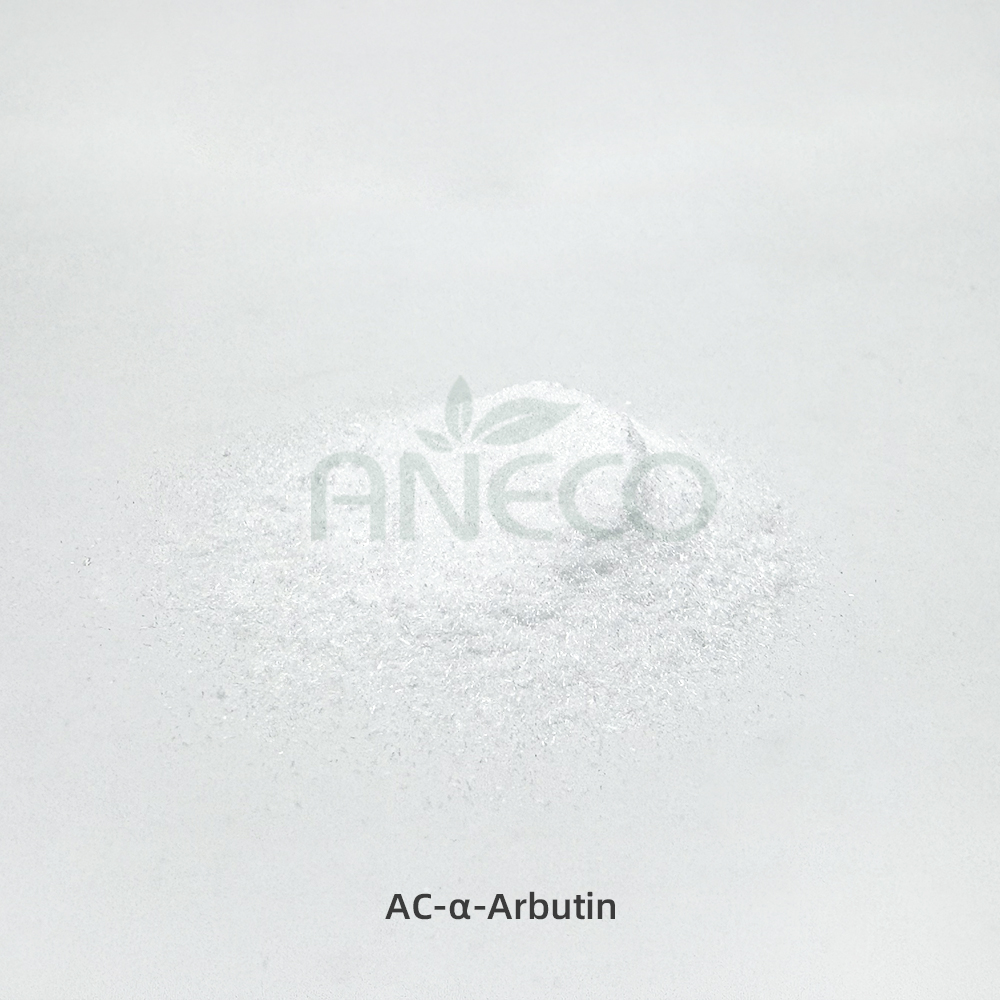
AC-α-Arbutin is ANECO Alpha-Arbutin produced through an enzyme-based biotechnology process for brightening serums, creams, lotions and BB/CC formulas. It contains at least 99% Alpha-Arbutin by HPLC, is highly soluble in cold water, inhibits tyrosinase and controls hydroquinone to no more than 10 ppm.
Product Identity
Review identity, assay, hydroquinone control and microbial limits before formulation or procurement qualification.
| Product Name | AC-α-Arbutin | INCI Name | Alpha-Arbutin |
|---|---|---|---|
| CAS No. | 84380-01-8 | EC / EINECS No. | 440-470-8 |
| Molecular Formula | C12H16O7 | Molecular Weight | 272 g/mol |
| Appearance | White crystalline powder | Assay | ≥99.0% |
| Clarity of Water Solution | Transparent, colorless, with no suspended matter | pH | 5.0-7.0 |
| Loss on Drying | ≤1.0% | Residue on Ignition | ≤0.5% |
| Hydroquinone | ≤10 ppm | Heavy Metals | ≤10 ppm |
| Total plate count | ≤1,000 cfu/g | Yeast & Molds | ≤100 cfu/g |
An enzyme-based biotechnology process supports consistent production of high-purity Alpha-Arbutin.
Hydroquinone and heavy metals are each controlled to no more than 10 ppm.
Solubility reaches 151 g/L at 20°C, supporting water-phase incorporation with temperature and oxidation control.
Use-Level and Process Windows
Recommended use levels vary by product area and formula format; confirm final limits for the target market.
| Face and Neck Products | Up to 2.0%. |
|---|---|
| Body Products | Up to 0.5%. |
| Exfoliant / Penetration-Enhancer Systems | Up to 0.2%. |
| BB / CC Creams | 0.5-2.0%. |
| Recommended Formula pH | 5-7 for stability screening. |
| Processing Temperature | Below 40°C is preferred. |
Performance
IC50 of 1.0 mmol/L in a human-cell-lysate tyrosinase test, plus a one-month 1% Alpha-Arbutin emulsion study with 80 participants.
IC50: 1.0 mmol/L in a human-cell-lysate tyrosinase test.
IC50: 9.0 mmol/L in the same tyrosinase test.
One-month clinical study demonstrated superior brightening efficacy of 1% α-Arbutin compared with β-Arbutin.
Three-month clinical study showed significant improvement in liver spots.
Helps reduce excess melanin formation by inhibiting tyrosinase activity.
151 g/L water solubility at 20°C for serums, essences, lotions and creams.
Compatible with UV filters and ethanol, subject to stability testing.
Pairs with niacinamide and an antioxidant system to help control color change.
Application
Protect Alpha-Arbutin from unnecessary heat and oxidation while controlling pH and finished-product use level.
Confirm current target-market concentration limits, impurity requirements and claim wording before commercial release.
Documents and Support
Request the current specification and supporting study package before finalizing claims or target-market compliance.
Enzyme-produced, high-purity Alpha-Arbutin with assay at least 99%, high cold-water solubility and hydroquinone controlled to not more than 10 ppm for cosmetic brightening applications.
Ask for the documents needed for specification review, regulatory review, sample testing and bulk order qualification.
FAQ
Answers to common buyer questions about hydroquinone control, use level, processing, applications and test data.
AC-α-Arbutin is used in brightening serums, creams, lotions, masks, sun care formulas and BB/CC creams.
Hydroquinone is controlled to not more than 10 ppm.
Recommended levels are up to 2.0% for face and neck products, up to 0.5% for body products, and 0.5-2.0% for BB/CC creams. Confirm the final level against current target-market requirements.
Dissolve it in the water phase, preferably below 40°C, and maintain the finished formula at pH 5-7 while controlling oxidation and color.
AC-α-Arbutin inhibits tyrosinase to help reduce excess melanin formation. The one-month finished-emulsion test used 1% Alpha-Arbutin, so finished-product claims should follow the tested formula and conditions.
Document Request
Request technical documents for specification review, regulatory review and sample evaluation.

Tel: +86 25 6606 0698
E-mail: [email protected]
Business Hours: Mon–Fri,
09:30–12:30 & 14:00–17:30 (GMT+8)


