


 Request a Sample
940 Self-Wetting
Compared with an international benchmark sample, AC-Carbomer 940 reaches self-wetting in 40 min at 0.2 wt%.


Cosmetic Grade Carbomer
INCI name: Carbomer | Acrylates/C10-30 Alkyl Acrylate Crosspolymer
A MAGICAL THICKENING AGENT
ANECO Carbomer Series covers AC-Carbomer 940, 980, U20 and U21 for skincare, personal care and home care formulations. After neutralization, these cross-linked acrylic polymers build transparent gel matrices for efficient thickening, suspension and O/W emulsion stabilization at low use levels. REACH compliance support and benzene-free solvent control help procurement teams review raw-material documentation with greater confidence.
Type Comparison
Compare AC-Carbomer 940, 980, U20 and U21 by INCI, CAS No., dosage and dispersion behavior before sample testing.
| Product Name | AC-Carbomer 940 / 980 / U20 / U21 |
|---|---|
| INCI / Chemical Name | 940 / 980: Carbomer U20 / U21: Acrylates/C10-30 Alkyl Acrylate Crosspolymer |
| CAS No. | 940 / 980: 9003-01-4 U20 / U21: N/A |
| Appearance | Fluffy white powder |
| Technical Role | Cosmetic rheology modifier, transparent gel thickener, suspending agent and O/W emulsion stabilizer |
| Solubility / Dispersibility | Dispersible in water, ethanol/water and glycerol systems. U20 / U21 provide rapid self-wetting for automated or high-throughput production. |
| Recommended Dosage | 940 / 980: 0.2% - 1.0% U20 / U21: 0.2% - 1.5%, adjusted by target viscosity, clarity and electrolyte load. |
Clear gels, serums, creams, lotions, hydroalcoholic gels, hair styling gels, shampoos, body washes and sunscreen lotions.
Recommended swelling and dispersion temperature for carbomer is below 30°C. For Carbomer U20 and U21, sprinkle the powder into the stationary aqueous phase, allow it to wet naturally before neutralization.
It exhibits good compatibility with nonionic surfactants and nonionic preservatives. For formulations containing high levels of electrolytes, cationic raw materials or excessive heavy oils, appropriate carbomer types shall be selected and small-scale trials conducted in advance.
Performance
Review 940 / 980 advantages against international benchmark samples, including clear gel appearance, faster self-wetting, suspension support and salt-tolerance screening before sample testing.
Compared with an international benchmark sample, AC-Carbomer 940 reaches self-wetting in 40 min at 0.2 wt%.
Compared with an international benchmark sample, AC-Carbomer 980 reaches self-wetting in 20 min at 0.2 wt%.
The self-wetting comparison uses 0.2 wt% carbomer concentration for 940 and 980 screening.
Test comparison data under 0.1 wt% NaCl positions Carbomer 980 for strong viscosity retention under salt challenge.
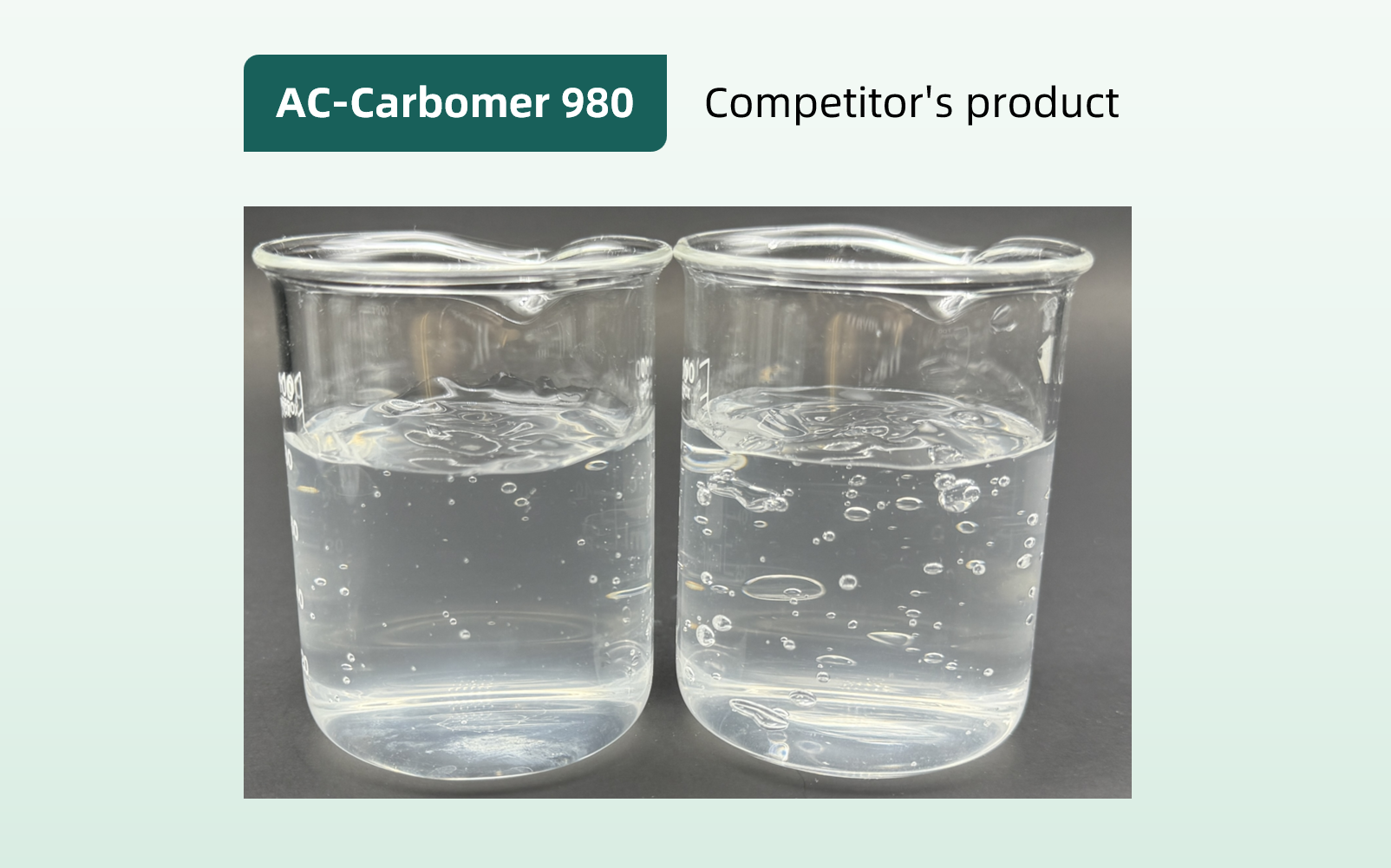
Carbomer 980 sample comparison highlights high transparency with fewer bubbles for refined gel systems.
After neutralization, 940 and 980 build polymer networks that support thickening, suspension and O/W emulsion stabilization.
AC-Carbomer 940 and 980 show faster self-wetting performance than the tested international benchmark samples.
940 and 980 are positioned for clear gels, creams, lotions, hydroalcoholic gels and other personal care systems.
Application
Use these practical guidelines to hydrate, neutralize and test AC-Carbomer types in cosmetic formulations.
Avoid direct dispersion into saline or ion-containing water. Cationic surfactants and quaternary ammonium preservatives may cause flocculation, while high electrolyte levels, clay minerals and heavy metal ions can reduce gel clarity and viscosity.
Documents and Support
Review public product positioning and request type-specific files for regulatory review, comparison testing and bulk purchasing.
Cosmetic grade carbomer, rheology modifier, transparent gel thickener, suspension stabilizer, O/W emulsion support, rapid wetting and technical formulation support.
Ask for the files needed to confirm specifications, regulatory review, sample testing and bulk order qualification.
FAQ
Answers to common buyer questions about dosage, benchmark comparison, type selection, formula compatibility and order documents.
Use 0.2% - 1.0% for AC-Carbomer 940 / 980 and 0.2% - 1.5% for AC-Carbomer U20 / U21. Final dosage should be confirmed by target viscosity, gel clarity, electrolyte level and product format.
AC-Carbomer 940, 980, U20 and U21 should be evaluated in the customer's own formula. Key indicators such as viscosity, clarity, pH, electrolyte tolerance, wetting behavior and finished-product sensory performance should be tested before scale-up.
Choose 940 for high-clarity short-rheology gels, 980 for high viscosity with useful suspension support, U20 for long rheology and stronger electrolyte tolerance, and U21 when fast wetting, high transparency and a fresher non-sticky feel are priorities.
After neutralization, carbomer forms a hydrated polymer network that builds viscosity, improves clear gel structure and helps suspend particles or droplets. AC-Carbomer 980 and U20 also show stronger dispersion and suspension behavior than benchmark samples.
Compatibility depends on the type and formula load. Nonionic surfactants generally work well; high electrolytes, cationic materials, some ionic preservatives, powders with metal ions and high levels of acidic actives should be screened because they may reduce viscosity or clarity.
ANECO can provide type-specific TDS, SDS or MSDS, specifications, COA samples and formulation support for AC-Carbomer 940, 980, U20 and U21. MOQ, packaging and lead time can be confirmed during sample or quotation discussion.
Document Request
Request carbomer technical documents for specification review, regulatory review and sample evaluation.

Tel: +86 25 6606 0698
E-mail: [email protected]
Business Hours: Mon–Fri,
09:30–12:30 & 14:00–17:30 (GMT+8)


