What Is Liquid Crystal Emulsification? Effects, Methods, and How to Choose the Right Emulsifier
Date:August. 11 2026
share:
At ANECO, we define liquid crystal emulsification as a way to build more structure into a cosmetic emulsion. Instead of simply dispersing oil droplets in water, the system creates ordered layers at the oil-water interface and, in some formulas, throughout the cream base. For formulators, that structure matters when a product needs stronger stability, better moisturization, refined sensory feel, or a more controlled environment for difficult actives.
We most often see this approach used when a formula brief asks for more than basic oil-water mixing: a barrier cream that must hold viscosity after heat aging, a sunscreen that must keep filters dispersed, a retinol cream that needs a softer delivery profile, or a high-oil moisturizer that should feel rich without drag.
Why R&D Teams Use Liquid Crystal Emulsification
In product development, liquid crystal emulsification usually enters the conversation after a conventional emulsion starts showing limits.
In our formulation support work, we pay close attention to what happens after the first smooth batch. A rich moisturizer may pass the overnight check, then lose yield value or become thinner during 40-45°C heat aging. A sunscreen may look uniform at first, but later show UV filter settling, particle agglomeration, or viscosity drift after electrolyte adjustment. A retinol cream may have a polished pickup before the active system is added, then feel sharper on skin during sensory screening. For sensitive-skin formulas, the real challenge is keeping the base mild and clean while preserving the cushion, body, and rub-out expected from a premium cream.
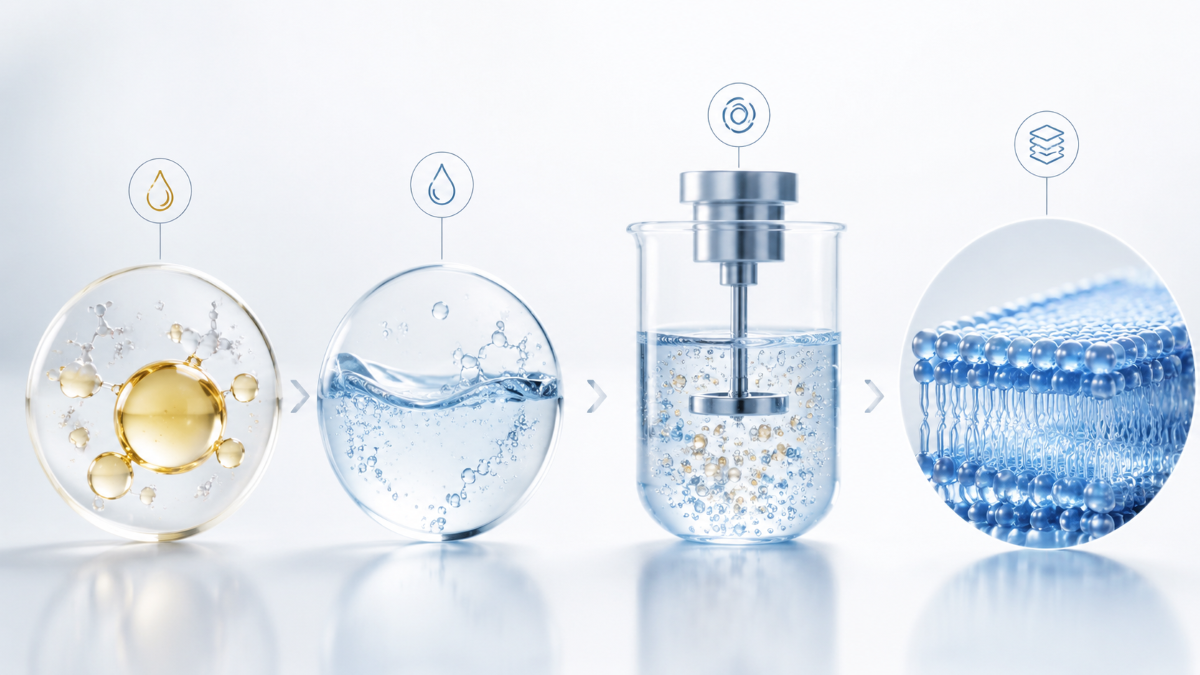
Liquid crystal systems help because they add architecture. The emulsifier and co-structuring ingredients arrange into layered phases, with hydrophilic portions facing water and lipophilic chains aligning with oil. These layers can reinforce the interface, hold water more evenly, and create a smoother break on skin.
That makes the technology especially relevant for B2B formulation work. It gives the chemist more control over oil loading, viscosity, rub-out, active compatibility, and long-term appearance.
Liquid Crystal Emulsion vs. Conventional Emulsion
A conventional emulsion mainly depends on droplet dispersion and interfacial tension reduction. The emulsifier helps keep oil and water from separating. This works well for many simple lotions and creams.
A liquid crystal emulsion adds a structured lamellar phase. The formula still contains oil, water, and emulsifier, but the interface behaves more like an organized network than a simple boundary. In practice, that can mean better resistance to creaming, a more stable viscosity curve, and a more refined after-feel.
Formulation Point
Conventional Emulsion
Liquid Crystal Emulsion
Main structure
Dispersed droplets
Droplets plus lamellar layers
Stability route
Interfacial tension control
Interface reinforcement and phase organization
Skin feel
Can feel light, greasy, or waxy depending on system
Often smoother, richer, and more controlled
Moisturizing support
Mainly from humectants and oils
Humectants, oils, and structured water-holding layers
Best fit
Simple lotions, cleansers, standard creams
Barrier care, anti-aging, sunscreen, sensitive-skin creams
The difference becomes clearer under stress testing. A formula that looks acceptable at room temperature may behave very differently after centrifugation, freeze-thaw, 45°C storage, pH adjustment, or active loading.
How Liquid Crystal Structures Form
Most cosmetic liquid crystal emulsions use amphiphilic ingredients. These molecules contain both water-loving and oil-loving portions. Under the right conditions, they self-assemble into ordered phases.
Lamellar structures are the most common in skin care. They resemble stacked layers, which is why they are often discussed in relation to the skin barrier. The stratum corneum also relies on organized lipid layers to reduce water loss and maintain barrier function. A cosmetic emulsion does not duplicate the skin barrier, but a lamellar base can support a more skin-relevant texture and moisturization profile.
Several formulation factors influence whether the structure forms well:
Factor
Why It Matters
Emulsifier chemistry
Determines whether lamellar organization is possible
Fatty alcohol or lipid partner
Helps build body and layered structure
Oil polarity
Affects droplet behavior and interface strength
Water phase composition
Electrolytes, humectants, and pH can shift structure
Heating and cooling
Poor temperature control can weaken lamellar formation
Shear level
Too little mixing gives poor dispersion; too much may disturb structure
This is one reason liquid crystal emulsification should be developed as a system, not as a single ingredient swap. The emulsifier choice matters, but so do the oil phase, processing sequence, and final stability protocol.
Main Effects in Finished Skin Care
The most visible benefit is usually stability. A liquid crystal network can help protect oil droplets from merging, especially in formulas with higher oil content, UV filters, silicones, botanical extracts, or active ingredients.
The sensory benefit is just as important. Premium creams often fail because the texture sends the wrong signal. A formula may be stable but feel waxy, sticky, or slow to absorb. Lamellar systems can create a richer pickup with a cleaner rub-out, which is useful for night creams, recovery creams, eye creams, and nourishing lotions.
Moisturization is another reason formulators use this approach. Liquid crystal structures can help hold water within ordered layers and slow water loss from the applied film. For barrier-focused products, this gives the formula a stronger technical story than a simple oil-and-humectant base.
Active delivery is the fourth major benefit. Retinol, vitamin C derivatives, AHAs, and sunscreen filters can be difficult to stabilize or make comfortable on skin. A structured emulsion base can help distribute these materials more evenly and soften the delivery profile. Claims such as “controlled release” or “reduced irritation” should still be supported by finished-formula testing.
How Liquid Crystal Emulsification Is Made in Practice
In practice, liquid crystal emulsification is created through phase preparation, emulsification, and controlled cooling. The goal is not only to disperse oil into water, but to give amphiphilic ingredients enough time and mobility to arrange into an ordered interfacial structure.
For a lamellar O/W cream using AC-M68 SV, the oil phase and AC-M68 SV should first be heated until the emulsifier and other structuring materials are fully melted and uniform. The pre-heated water phase is then combined with the oil phase under stirring, followed by homogenization to form a fine O/W emulsion. During cooling, the emulsifier system begins to organize around the oil-water interface and within the cream base, forming the layered structure that gives the emulsion body and stability.
Different emulsifier chemistries require different hydration, heating, and phase-addition strategies during processing. Some systems work best when the oil and wax phase is fully melted before emulsification. Others need to be hydrated or dissolved in the water phase before the oil phase is introduced. Poor temperature control, rushed cooling, or mismatched shear can leave the formula smooth at first but weak after heat aging or freeze-thaw testing.
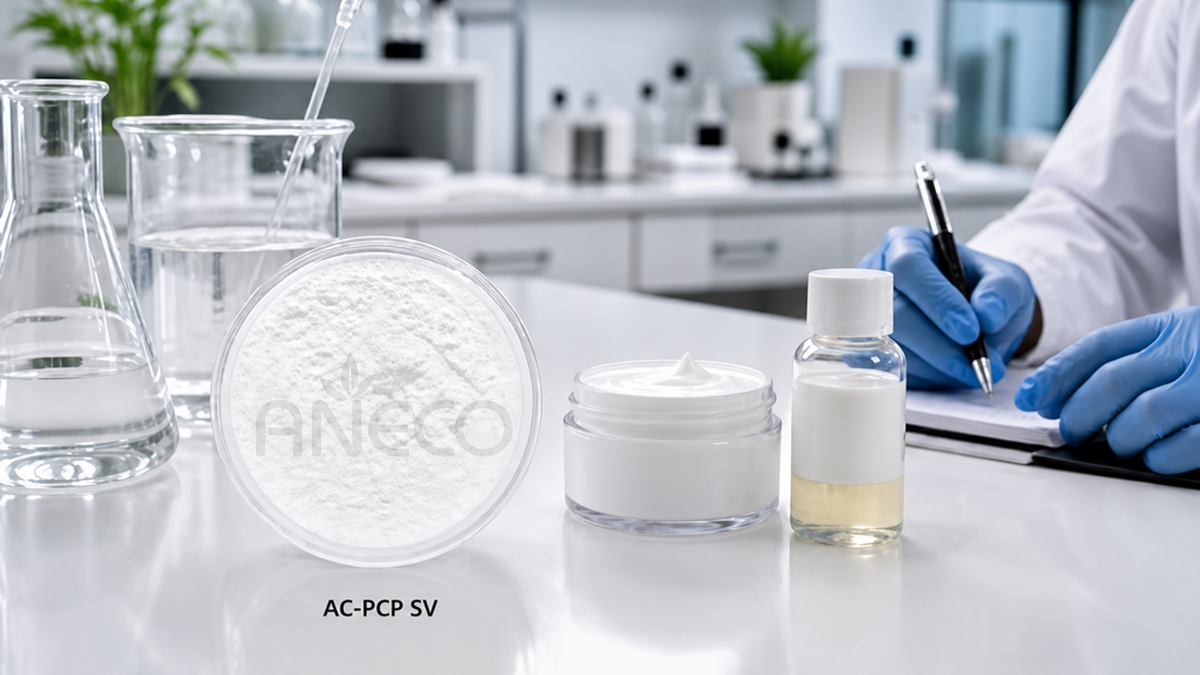
Different emulsifier chemistries need different processing windows. For high-oil sunscreens and makeup bases, AC-PCP SV Potassium Cetyl Phosphate emulsifier provides an anionic, EO-free O/W route. ANECO’s product data reports that 1% AC-PCP SV can emulsify up to 80% oil phase in the supplier’s screening system. When using the 70-75°C water-phase preparation route from ANECO process guidance, formulators should confirm the same temperature, shear, and cooling profile in their own oil phase and batch size.
For nonionic lamellar O/W creams, AC-M68 SV natural O/W liquid crystal emulsifier links the emulsifier and structure-building roles in one Cetearyl Glucoside/Cetearyl Alcohol system. ANECO’s product page reports that 0.5% AC-M68 SV can emulsify 30% oil phase in centrifugation screening. Treat this as an early formulation benchmark; final dosage should be confirmed against the customer’s oil polarity, fatty alcohol level, active package, and stability protocol.
The final structure should be checked in the finished formula. Useful tests include centrifugation, 40-45°C aging, freeze-thaw cycling, viscosity tracking, pH drift, droplet observation, microscopy, and sensory review. A liquid crystal emulsion should be judged by how well the finished product holds structure after processing and active loading.
How to Choose the Right Liquid Crystal Emulsifier
After the processing route is clear, the next step is to match the emulsifier to the formula brief. The right choice should support the required structure, survive the production process, remain compatible with the active system, and deliver the intended skin feel after stability testing.
Product format comes first. For sensitive-skin creams, baby-care lotions, barrier moisturizers, and retinol creams, ANECO usually screens a nonionic lamellar O/W route first because mildness, soft cream body, and active compatibility matter more than maximum oil loading. A Cetearyl Glucoside/Cetearyl Alcohol system such as AC-M68 SV is a relevant starting point.
Oil phase narrows the route. A 10% ester lotion, a 25% nourishing cream, and a sunscreen with UV filters or pigments create different emulsification challenges. When oil loading, UV filters, pigments, or silicone oils create viscosity drift, a phosphate-based O/W route such as AC-PCP SV deserves early bench screening.
Active compatibility decides whether the prototype is useful. AHAs, vitamin C derivatives, retinoids, botanical extracts, salts, cationic conditioners, and mineral filters can all change viscosity, pH, droplet size, or appearance. The emulsifier should be screened in the real active base, not only in a simplified lab cream.
Claim support closes the decision. A barrier-care product needs hydration or TEWL support. A sunscreen needs filter dispersion, film uniformity, and water-resistance testing. A retinol cream needs active compatibility and irritation-profile review.
Formulation Goal
What to Screen First
Emulsifier Direction
Sensitive-skin or baby-care lotion
Mildness, pH range, active compatibility
Nonionic lamellar O/W system
Barrier cream or long-hydration moisturizer
Lamellar structure, rich sensory, hydration support
Nonionic liquid crystal system with fatty alcohol support
Retinol, AHA, or vitamin C cream
pH stability, viscosity after aging, irritation profile
Mild nonionic lamellar system
Sunscreen or makeup base
UV filter dispersion, oil loading, film quality
Phosphate-based O/W liquid crystal emulsifier
Silicone-rich remover or high-oil cream
Oil compatibility, centrifugation, rub-out
Structured O/W system with high oil tolerance
Scale-up-sensitive formula
Heating, cooling, shear repeatability
System with clear process guidance
Need Help Selecting a Liquid Crystal Emulsifier
Selecting a liquid crystal emulsifier is easier when the formula brief is clear. Key factors include oil phase percentage, target pH, active ingredients, electrolyte level, required skin feel, processing temperature, and the type of stability testing planned.
For a sensitive-skin moisturizer or barrier cream, a nonionic lamellar O/W system may be a practical starting point. For sunscreen, makeup base, or high-oil emulsions, a phosphate-based O/W emulsifier may offer better support for oil loading and film formation.
If your team is comparing liquid crystal emulsifier options, share the oil phase, target pH, active package, sensory goal, and planned stability tests through Contact ANECO. We can help assess whether AC-M68 SV, AC-PCP SV, or another structure-building route is the better first lab screen.
FAQ
1. What is liquid crystal emulsification in cosmetics?
Liquid crystal emulsification creates ordered layered structures in an emulsion, helping oil and water stay stable while improving texture, hydration, and active delivery.
2. What are the main benefits of liquid crystal emulsions? They can improve emulsion stability, reduce viscosity drift, create a smoother skin feel, support long-lasting moisturization, and help distribute actives more evenly.
3. How is a liquid crystal emulsion made?
It is usually made through controlled phase heating, emulsification, and cooling. The emulsifier system needs time to form lamellar layers around the oil-water interface.
4. Which products are suitable for liquid crystal emulsification?
Common applications include barrier creams, sensitive-skin moisturizers, retinol creams, sunscreens, baby-care lotions, makeup bases, and high-oil emulsions.
5. How do you choose the right liquid crystal emulsifier?
Start with the product type, oil phase, active ingredients, pH, process conditions, and claim requirements. Then verify performance through stability and sensory testing.
By clicking "Accept," you agree to the storing of cookies on your device to enhance site navigation, analyze site usage, and assist in our marketing efforts.