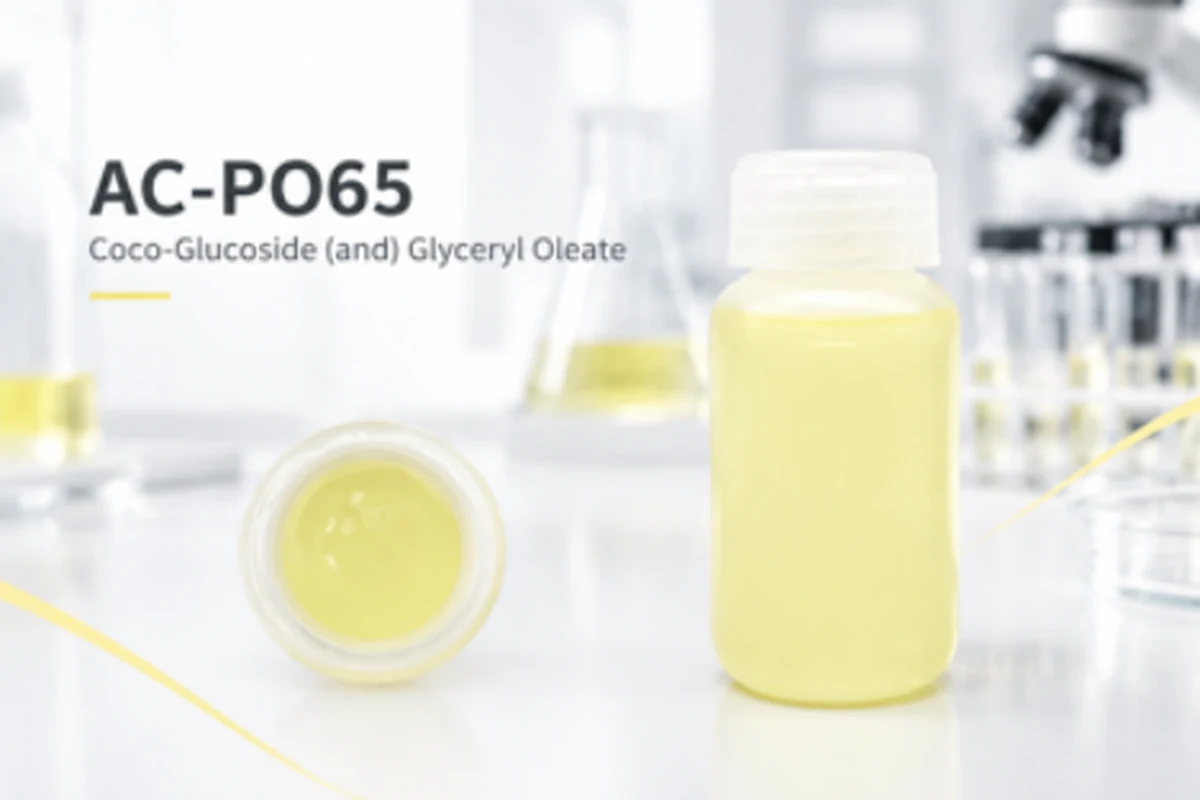
Mild cleansers should remove daily buildup and leave skin feeling comfortable after rinsing. Coco-Glucoside and Glyceryl Oleate support this balance through cleansing and refatting, helping skin feel softer after washing. Adding refatting ingredients can also change foam and texture: conventional oils may reduce lather or lower viscosity in some cleanser formulas. Our AC-PO65 combines Coco-Glucoside and Glyceryl Oleate to provide refatting support while contributing to foam stability and viscosity in facial cleansers, body washes, and shampoos. The right use level balances after-rinse comfort with the foam and texture required for each formula.
How Coco-Glucoside and Glyceryl Oleate Work Together in Mild Cleansers
Coco-Glucoside (and) Glyceryl Oleate is the INCI name for a blend with two complementary roles. Coco-Glucoside is a nonionic alkyl polyglucoside (APG) surfactant that provides wetting, cleansing, and foam formation. Its water-loving and oil-loving parts help bring oily soil into the wash water for removal during rinsing, as explained in our guide to alkyl polyglucoside structure.
Glyceryl Oleate is a fatty-acid ester used for its emollient and refatting properties. Within the blend, its main role is to condition the skin during washing and leave a softer feel after rinsing. This complements the cleansing action of Coco-Glucoside.
How Refatting Supports Mild Cleansing and Post-Rinse Comfort
The skin’s outer layer contains cells surrounded by organised lipids that help retain moisture. Cleansing surfactants remove dirt and excess oil. Their interaction with skin lipids and proteins can also contribute to dryness and irritation. A review of soaps and syndet cleansers explains how cleanser composition and pH influence skin compatibility.
Refatting helps improve skin feel after cleansing. Glyceryl Oleate can support lipid deposition and leave skin feeling softer after rinsing. The surfactant blend also plays a central role in mildness. Research on barrier-friendly cleanser design explains how formulation choices can reduce surfactant interaction with the skin barrier.
A well-designed cleanser balances effective cleaning, easy rinsing, and a comfortable after-feel. This balance depends on the complete formula, including surfactant concentration, pH, and refatting ingredients. Our guide to mild surfactant types explains the main ingredient families and their uses across cleansing applications.
ANECO AC-PO65: Product Specifications for Mild Cleansers
AC-PO65 combines Coco-Glucoside and Glyceryl Oleate for mild rinse-off cleansers, including sulfate-free formulas. Its refatting function helps skin feel softer after washing. It also contributes to foam stability and viscosity, helping formulators balance after-rinse comfort, lather, and texture. The need for a separate thickener depends on the complete surfactant system.
AC-PO65 supports cold processing. It can be incorporated into a suitable surfactant base without heating, which simplifies mixing when the other ingredients are also cold-processable. Its Natural Origin Index of 1 supports selection for formulas with natural-origin ingredient targets.
AC-PO65 Specifications at a Glance
Parameter
ANECO AC-PO65
Product / INCI
AC-PO65; Coco-Glucoside (and) Glyceryl Oleate
Appearance
Transparent to slightly yellowish viscous liquid
Solids content
64.0–68.0%
pH
3.0–4.0 in a 5% aqueous solution
Density at 20°C
1.06–1.10 g/mL
Recommended screening level
1–5%
Formulation role
Refatting, viscosity contribution, foam stability, and oil dispersion
Typical applications
Facial cleanser, body wash, foam bath, shampoo, and baby-care cleanser
These specifications describe the supplied raw material. The listed pH is measured in a 5% aqueous solution. The finished cleanser needs a pH suited to its formula and intended use.
AC-PO65 is supplied preservative-free. The finished water-based cleanser still needs a suitable preservation system to control microbial growth during storage and use.
Our company-wide QA/QC system covers supplier audits, raw-material inspection, production controls, final product testing, and traceability. For purchasing decisions, we recommend matching the lot number on the supplied material to its batch certificate of analysis (COA), then comparing the reported results with the agreed raw-material specification.
Choosing AC-PO65 for Facial Cleansers, Body Washes, and Shampoos
Our recommended use range for AC-PO65 is 1–5%. Within this range, selection depends on the product format and the desired feel during washing and after rinsing.
Facial cleansers often prioritise a clean rinse with little residue. Body washes may favour creamy lather and a comfortable after-feel. Shampoos need to balance foam, wet combing, and scalp comfort. These priorities guide the choice of AC-PO65 level, while the complete surfactant base shapes its contribution to each formula.
Our APG surfactant range includes individual alkyl polyglucoside grades and related blends. When comparing options for a mild rinse-off cleanser, you can use INCI identity, carbon-chain range, active matter, and intended application to narrow the selection.
Common AC-PO65 Formulation Mistakes
1. Increasing the dosage without considering foam, viscosity, and rinse feel. Higher AC-PO65 levels can also change foam, viscosity, clarity, and residue. The right level balances after-rinse comfort with the product’s cleaning and rinsing targets.
2. Using the raw material’s pH as the finished-product target. AC-PO65’s listed pH of 3.0–4.0 is measured in a 5% aqueous solution. The finished cleanser needs a pH suited to its complete formula and intended application.
3. Counting solids content as active surfactant content. The solids range covers the supplied blend, including its refatting component. Calculations of total surfactant active matter need to account for the blend’s composition.
4. Expecting AC-PO65 to handle cleansing and thickening on its own. The blend supports refatting and foam stability. AC-PO65 contributes to cleansing, while overall cleaning performance and viscosity depend on the complete surfactant system and formula. A separate thickener may help achieve the desired texture.
Frequently Asked Questions
Can Coco-Glucoside and Glyceryl Oleate be used in cleansers for sensitive skin?
Coco-Glucoside and Glyceryl Oleate can be considered for cleansers developed for sensitive skin. The blend helps improve comfort after washing. Overall skin compatibility also depends on the surfactant concentration, pH, fragrance, and preservation system. Testing the finished cleanser helps establish its suitability for the intended users.
How should Coco-Glucoside and Glyceryl Oleate be added to a cleanser formula?
Our AC-PO65 is cold-processable and can be incorporated into a suitable surfactant base without heating. Keep the addition order and mixing time consistent when comparing trial batches. After mixing, check pH and viscosity against the product targets, then evaluate foam and rinse feel.
What supplier information matters when sourcing Coco-Glucoside and Glyceryl Oleate?
The most useful information includes the INCI name, solids content, pH test conditions, preservative status, and storage requirements. These details provide a clear basis for comparing grades. Our AC-PO65 specifications distinguish raw-material properties from finished-cleanser targets, helping formulators interpret the data during product development.
Is Coco-Glucoside and Glyceryl Oleate compatible with other surfactants?
The blend can be considered for formulas containing anionic, amphoteric, or nonionic surfactants. Foam texture, viscosity, and rinse feel vary with the surfactant combination. The formula’s pH and electrolyte level also influence these properties, so compatibility depends on the complete formula.
Conclusion
Consider our AC-PO65 when a softer after-rinse feel is a priority. Its cold-processability is an additional advantage for compatible formulations.
Contact our team to request product specifications, technical documentation, or samples.
By clicking "Accept," you agree to the storing of cookies on your device to enhance site navigation, analyze site usage, and assist in our marketing efforts.