What Is Dimethyl Isosorbide (DMI)? Solvent Properties, Applications, Safety, and Formulation Guide
Date:October. 14 2026
share:
Dimethyl isosorbide (DMI) is a sugar-derived solvent used in cosmetics to dissolve active ingredients and influence their delivery to skin. Its value lies in helping an active fit the intended product, whether that is a facial serum, a cream, or a self-tanner. At ANECO, we supply AC-DMI for this solvent role. Understanding its properties, applications, and safety starts with a practical distinction: the solvent supports incorporation and delivery, the active provides the intended skincare function, and the finished cosmetic shapes the user experience. Keeping those roles clear makes it easier to judge what DMI contributes.
What Is Dimethyl Isosorbide?
Dimethyl Isosorbide is both the ingredient’s chemical identity and its INCI name on cosmetic labels. The CAS number is 5306-85-4, and isosorbide dimethyl ether is another name for the same substance. In personal care, it belongs to the solvent and carrier part of a formula.
An anti-aging active provides the intended skincare activity; the carrier helps incorporate that ingredient into a usable product. This makes the solvent relevant to both ingredient selection and the development of the finished serum or cream. Its role begins with making an active available in a suitable liquid medium.
AC-DMI names the solvent itself. A prepared active solution is a different commercial material because it combines DMI with an active at a defined concentration. This identity distinction matters in specifications, calculations, and purchasing records, where the solvent and the active solution should not be treated as interchangeable materials.
Is Dimethyl Isosorbide Safe for Skin?
A cosmetic solvent has to do more than dissolve an active. In leave-on skincare, the carrier remains in contact with skin, so tolerance matters alongside delivery performance. Different solvent systems bring different trade-offs, making safety an early part of ingredient selection. For DMI, the relevant question is how it performs at the intended concentration and in the intended product format.
Our HPR-in-DMI patch test provides a concrete reference. A solution containing 0.5% HPR in DMI was applied under occlusion for 24 hours in 32 participants aged 28–60. The occlusive setup maintained contact between the tested solution and the skin throughout the exposure period. No positive irritation reactions were reported at the 48-hour observation.
The patch test records the skin response to the HPR-in-DMI combination under controlled contact. A nightly facial treatment, cream, or rinse-off cleanser introduces its own use pattern, so finished-product testing focuses on the final format and the way people will apply it.
Which Solvent Properties Matter in Cosmetics?
Water Compatibility and Dissolving Power
DMI mixes with water and helps dissolve selected ingredients that water alone handles poorly. In a co-solvent system, it works alongside the main liquid rather than replacing the entire base. Water can provide most of a serum’s volume, while the additional solvent creates a more suitable environment for the chosen active. This combination gives formulators another way to incorporate an oil-soluble ingredient into a water-containing product.
AC-DMI can also be used with polyols and selected esters. That flexibility is useful across liquid and emulsion formats, where the carrier has to accommodate ingredients with different solubility characteristics. The practical benefit is greater choice in how an active is introduced into the intended cosmetic.
Low Volatility and Temperature Data
Volatility describes how readily a liquid evaporates. DMI’s relatively low volatility is relevant when selecting a carrier for a leave-on product. As a serum spreads over skin, evaporation changes the composition of the liquid film. A slowly evaporating solvent remains part of that film for longer, making its behavior after application an important consideration alongside its dissolving power.
Solubilization and Skin Delivery
Solubilization describes an ingredient dissolving in its carrier. Skin delivery concerns its movement into skin after application. Stability adds two further questions: whether the active stays evenly incorporated and whether it remains chemically intact during storage. The carrier can therefore affect initial incorporation, storage behavior, and what happens after application. DMI is used for both its solvent function and its influence on active delivery. A human study of niacinamide found that delivery varied across solvent systems, showing how the vehicle shapes the result.
In application development, we focus on two connected goals: incorporating the chosen active and supporting its intended use on skin. Dissolving power addresses the ingredient in the bottle; delivery work examines its behavior after application. This is why carrier selection matters in active-skincare development.
Where Is DMI Used in Skincare?
Active Serums and Facial Treatments
Serums and facial treatments are established applications for this solvent. These products bring targeted ingredients into a format designed for regular application. DMI helps dissolve selected actives within the liquid carrier, making it useful in products where active delivery is central to the brief. A facial serum, treatment lotion, or night cream can each benefit from a carrier chosen around the ingredient it contains.
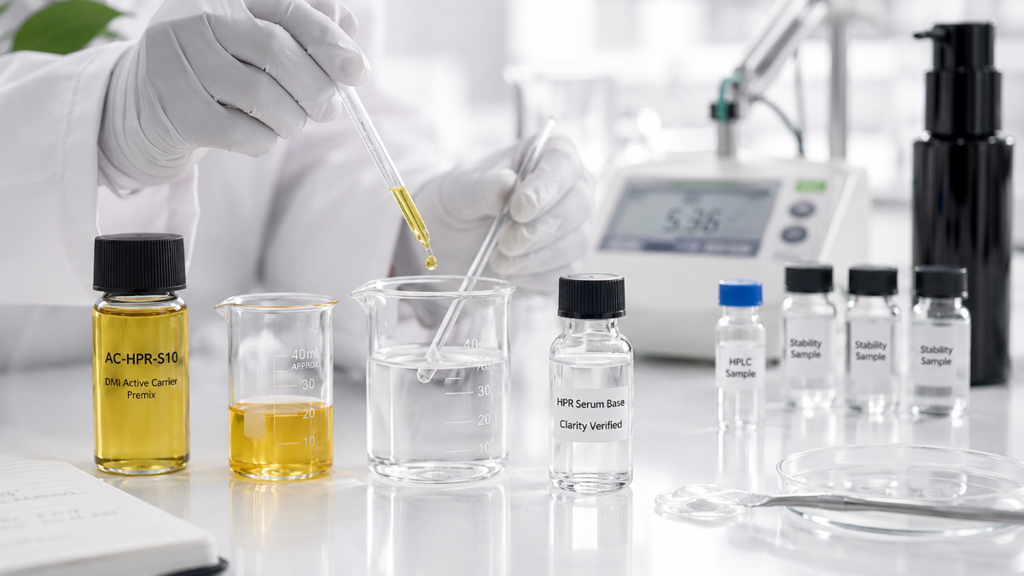
Retinoid skincare is a particularly relevant application. DMI provides a liquid carrier for an oil-soluble retinoid, a function we use in AC-HPR-S10.
Blemish-Care Products
Salicylic acid is relevant to blemish-care and exfoliating skincare, including products aimed at congested pores and uneven skin texture. AC-DMI is an option for supporting its incorporation into a cosmetic base. The acid provides the exfoliating function, while the solvent helps accommodate it within the product. This gives the ingredient a clear supporting role in targeted facial care, whether the intended format is a toner, serum, or treatment emulsion.
Self-Tanners and Other Personal Care Products
Dihydroxyacetone, or DHA, is the color-developing ingredient in sunless tanning products. Dimethyl isosorbide is used as a solvent in DHA-containing self-tanners, an established application extending beyond facial anti-aging care. A tanning lotion and a facial tanning serum may share the same active while offering different application experiences. The solvent supports the incorporation of DHA into the chosen product, keeping the carrier relevant to both facial and body tanning formats.
Eye-zone treatments and makeup removers are also intended applications for AC-DMI. In eye-area skincare, its solvent role supports selected treatment ingredients in a targeted leave-on format. In makeup removers, it forms part of the liquid carrier used to hold the product’s components. The two formats place different demands on the carrier: one supports a focused leave-on treatment, while the other supports a cleansing product that is removed after use. AC-DMI can serve both application types.
Choosing Between a Separate Solvent and a Prepared Active
We developed AC-HPR-S10 as a pre-dissolved HPR option using DMI as the carrier. It supplies 10% hydroxypinacolone retinoate in dimethyl isosorbide, bringing the active and its solvent together in a prepared liquid. The initial dissolution step is already completed, and the defined active content makes batch calculations more direct. This is a practical benefit for teams developing retinoid skincare with a ready-made active solution.
Our six-month room-temperature study found no detectable retinoic acid in serum and cream containing 1% AC-HPR-S10, at a detection limit of 0.0653 µg/mL. The measured endpoint was retinoic acid formation during storage. Together, the serum and cream results give development teams a concrete storage reference for the prepared HPR carrier.
The HPR range also offers other starting points. AC-HPR is an oil-soluble powder for projects that dissolve the active in a suitable oil phase. A water-based project has another option: AC-HPR-W2 SACOS, a water-dispersible liquid intended for aqueous incorporation. This format is useful when selecting an ingredient for a serum with little or no oil phase.
The choice follows the preferred way of introducing the active. A developer managing oil-phase dissolution can select the powder; a team seeking an HPR solution with its solvent already included can select S10. An aqueous concept points toward the water-dispersible format. Separate AC-DMI remains available when the active and solvent are being selected independently. The supplied active concentration then determines the amount of each commercial material used to reach the target HPR level.
What Matters When Sourcing the Solvent?
AC-DMI offers less impurity and less odor—two practical advantages when the sensory brief leaves little room for the carrier’s own smell. This matters in facial serums and other unfragranced products, where raw-material odor becomes part of the product’s scent profile. Dissolving power and odor therefore influence different parts of ingredient selection: one affects how the active enters the product, while the other shapes the sensory experience after application.
Technical specifications, a safety data sheet, and batch analysis help buyers assess AC-DMI before purchase. The technical data sheet identifies the material and its technical parameters, while the certificate of analysis reports results for a specific batch. When evaluating a sample, requesting its batch number and corresponding COA keeps the same material reference in view. This makes it easier to compare the tested sample with the material selected for purchase.
A useful sample request identifies the active, target level, and intended cosmetic format. Development quantity and expected order volume add the commercial context needed to match the sample and documentation to the project. Describing the target texture, application area, and whether the concept is leave-on or rinse-off also gives the technical team a clearer basis for the first discussion.
How to Choose a Cosmetic-Grade DMI Supplier
When sourcing cosmetic-grade DMI, do not stop at the product name. Ask for the current TDS, SDS, representative COA, analytical method, water and color limits, odor information, storage guidance, packaging details, and batch traceability. The impurity profile deserves close attention because solvent quality can affect odor, color, stability, and regulatory documentation. If pharmacopeial control is relevant to your project, USP-NF identifies dimethyl isomannide, dimethyl isoidide, and monomethyl isosorbide among named DMI-related organic impurities for chromatographic control.
The practical difference is not only in production scale. AC-DMI is positioned around lower impurity, lower odor, sugar-based sourcing, active-delivery support, and compatibility across water, oil, polyols, and esters. Formulators should still review current batch documents and test a sample in the intended formula before setting the final solvent level.
Frequently Asked Questions
What is dimethyl isosorbide used for in cosmetics?
In cosmetics, dimethyl isosorbide is used as a solvent or co-solvent for selected actives, a viscosity-control aid, and part of some carrier systems. ANECO lists AC-DMI for serums, facial and eye-zone treatments, anti-acne products, sunless tanners, makeup removers, emulsions, and anhydrous products. Its role should always connect to a defined formulation objective.
Is dimethyl isosorbide natural or synthetic?
AC-DMI is described by ANECO as sugar-based, but the finished molecule is produced through chemical conversion. “Sugar-based,” “bio-based,” and “natural” describe different concepts. Brands should confirm the manufacturing route and documentation required for their target market or certification scheme.
What percentage of DMI should be used?
No single percentage suits every formula. The level is influenced by the active, target concentration, solvent system, water content, pH, dosage form, sensory goal, and stability results. Begin with current supplier guidance, then establish the final amount through trials and analytical verification.
Can DMI replace propylene glycol or ethanol?
It can, but only when side-by-side testing supports the change. Compare active solubility, dilution stability, volatility, odor, skin feel, preservation, viscosity, packaging, and cost. A one-for-one substitution can shift the formula even when the active still looks clear.
Conclusion
Dimethyl isosorbide brings the greatest value when it solves a documented problem with active solubility, crystallization, uniformity, stability, or delivery. AC-DMI gives formulators an ANECO-specific option with lower impurity, lower odor, sugar-based sourcing, active-delivery support, and compatibility across water, oil, polyols, and esters. A successful premix is only the start: the full formula must remain stable, analytically consistent, packaging-compatible, and safe at the intended use level.
If you are developing a serum, retinoid system, anti-acne formula, sunless tanner, or other active-loaded product, our technical team can help you evaluate whether AC-DMI fits your solvent and carrier strategy. Request the current TDS, SDS, representative COA, and a sample to begin active-specific compatibility testing.
By clicking "Accept," you agree to the storing of cookies on your device to enhance site navigation, analyze site usage, and assist in our marketing efforts.