How to Formulate Tranexamic Acid for Skin Care: Dissolution, pH, and Compatibility
Date:October. 15 2026
share:
Tranexamic acid is used in skincare formulations targeting the appearance of dark spots and uneven skin tone. Incorporating it into a serum, gel, or emulsion brings three formulation questions into focus: how to dissolve the powder, which pH range suits the complete formula, and how to combine it with other brightening actives.
Using our AC-TA as an example, we explain water allocation for the premix and the distinction between premix concentration and finished-product use level. From there, shared pH ranges and ingredient-specific addition conditions guide the development of multi-active formulas, with controlled comparisons helping assess compatibility in the complete system.
Dissolution and Premix Planning
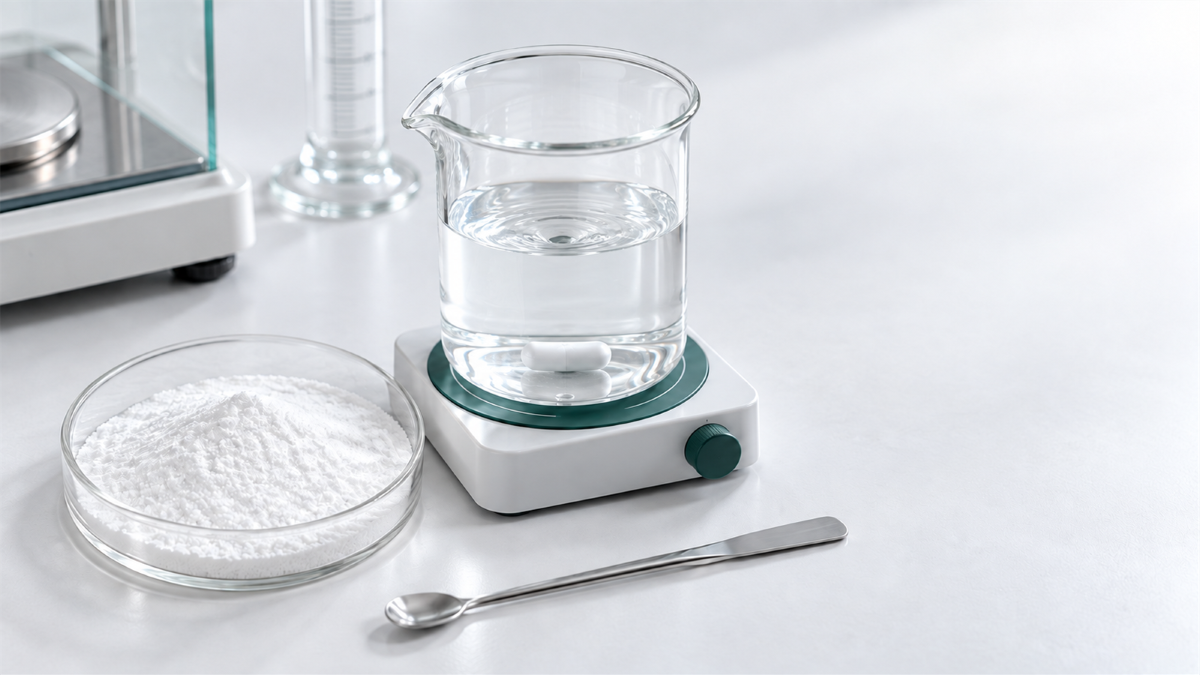
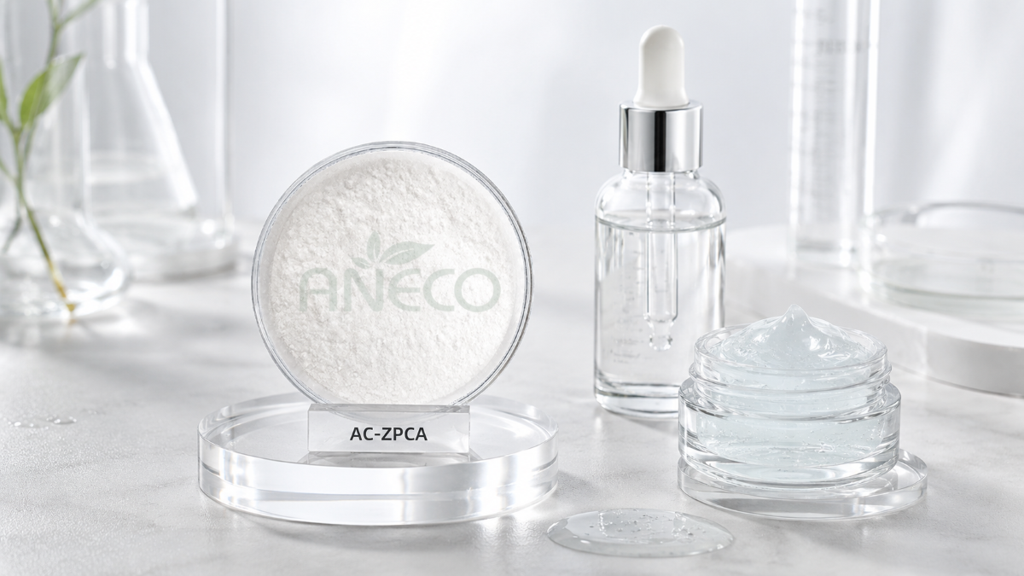
Our AC-TA (INCI: Tranexamic Acid) is a white crystalline powder with an assay specification of at least 99%. The suggested use level is around 3%, with direct dissolution in the water phase before emulsification.
The finished-product use level and premix loading use different denominators. The calculation for the preparation stage is:
Calculated AC-TA loading in the premix (% w/w) = AC-TA mass ÷ total premix mass × 100.
A planned 100 g batch containing 3 g of AC-TA could allocate 57 g of water to the premix. The calculated loading is 3 ÷ 60 × 100 = 5% w/w. Bringing the batch to its intended 100 g leaves the AC-TA input at 3% w/w. These are calculated input percentages, not measured solubility limits.
Water reserved for polymer hydration and cool-down solutions belongs to the same formula total. Reallocating that water changes the premix loading while keeping the final composition unchanged.
Retained premix and finished-formula samples can be compared after cooling under matching conditions. A batch record should capture the target batch size and final mass, water allocated to each phase or premix, mixing and addition temperatures, addition order, mixing time, and the identity, concentration, and amount of any pH adjuster. The stage at which a change appears guides the next test; appearance alone cannot identify its cause. Before comparing batches, account for any measured water loss and confirm the final mass against the calculation.
Choosing Tranexamic Acid Formulation pH
To select a target pH, distinguish among three different values. A raw-material specification describes a test solution prepared under defined conditions. A recommended formulation range guides ingredient use. The finished-formula pH is the value measured after the complete composition has been prepared.
AC-VCE illustrates this distinction. Its raw-material pH specification is 3.0–6.0 when measured in a 3% aqueous solution, while its recommended formulation range is narrower at pH 4.0–6.0. Treating the raw-material test-solution specification as a ready-made serum target would therefore use the wrong reference point.
The formulation ranges summarized in the following ingredient-handling table overlap at pH 5.0–6.0 for AC-TA, AC-VCE, and AC-α-Arbutin. For initial screening, we propose three evenly spaced finished-formula targets within this shared window: pH 5.0, 5.5, and 6.0. These values are screening points, not ingredient specifications or established stability optima. Other components in the complete formula may narrow the usable window.
Prototype
Target finished-formula pH
Role in the comparison
Lower-pH version
5.0
Tests the lower boundary of the shared formulation window
Midpoint version
5.5
Provides an intermediate reference without presuming a stability advantage
Higher-pH version
6.0
Tests the upper boundary of the shared formulation window
Using the batch-record controls described above, keep the base, active levels, final mass, and processing sequence matched across the three prototypes. After the complete composition is present, adjust each batch to its assigned target. Record the actual measured pH together with the identity, concentration, and dose of the pH adjuster, since the required dose may differ between prototypes.
Measure the samples at consistent temperatures and intervals, tracking pH drift alongside appearance and viscosity. Select the final target from the observed results and the finished product’s acceptance criteria.
These pH targets define the comparison window only. The incorporation route and processing temperature of each active still need to be controlled separately, as outlined in the next section.
Combining Brightening Actives with Different Processing Needs
Ingredient Handling and Screening Conditions
The handling conditions for our three ingredients connect each active with its incorporation route, pH range, and processing temperature. They guide prototype preparation; compatibility is assessed in the complete formula.
Ingredient
Incorporation route
Recommended formulation pH range
Addition conditions
Trial focus
AC-TA — Tranexamic Acid
Dissolve in water before emulsification
pH 3–9
High-temperature processing supported.
Dissolution and behavior after cooling
AC-VCE — 3-O-Ethyl Ascorbic Acid
Separate aqueous premix for emulsions
pH 4–6
Add after the emulsion cools below 45°C.
Color and active-content retention
AC-α-Arbutin — Alpha-Arbutin
Aqueous solution; cool-down addition
pH 5–7
Processing below 40°C preferred.
Color and response to processing
Recommended formulation screening range: pH 3.0–9.0 for AC-TA, subject to confirmation of stability and compatibility in the complete formulation.
In this emulsion sequence, AC-TA enters before emulsification, while AC-VCE and AC-α-Arbutin are reserved for cool-down. A shared addition stage below 40°C accommodates both cool-down recommendations. Preparing the two solutions separately allows their dissolution to be observed individually. A shared addition temperature alone does not establish compatibility between concentrated premixes.
Each solution is added and dispersed separately. The batch record should link each solution to its water content, addition temperature, and mixing time, making sequence changes easier to compare while the formula composition stays fixed.
The vitamin C conditions here apply specifically to 3-O-Ethyl Ascorbic Acid in AC-VCE. Another derivative brings its own handling requirements, even when the intended brightening concept stays the same.
What the Niacinamide + TXA Trial Actually Shows
Processing compatibility and performance evidence answer different questions. Niacinamide offers a separate example of how to interpret combination evidence. An eight-week randomized trial involving 42 Korean women compared a moisturizer containing 2% niacinamide and 2% tranexamic acid with its vehicle. Both groups used assigned sunscreen. The tested combination reduced the appearance of pigmentation more effectively than the vehicle regimen.
In development, we treat that finding as support for investigating the combination. The study evaluated one finished moisturizer and did not isolate the contribution of each active. A different base or use level needs its own performance assessment.
Adapting the Formula for Serums, Gels, and Creams
Water-based serums make clarity and flow especially important. Set the target appearance at the outset, then assess samples after entrained air has dissipated. Photographs taken in matching containers under the same lighting make small visual differences easier to follow. Comparing a cloudy sample with an aerated one can send troubleshooting in the wrong direction.
Gels add polymer behavior to the equation. With our AC-Carbomer Series, complete wetting and hydration come before neutralization. The chosen grade and total ingredient load influence the result, so an active-addition sequence developed for one gel cannot automatically be transferred to another. Follow the thickener’s processing guidance and compare the gel structure with and without the active blend.
Increasing polymer concentration immediately can obscure the cause of thinning. A small comparison that holds polymer level constant while changing the addition sequence is more informative. Once the sequence is settled, texture adjustments become easier to interpret.
Creams and lotions need a process that distributes late additions through an already structured emulsion. Match the mixing conditions to the emulsifier system, then compare samples from different points in the batch. Uneven incorporation can otherwise look like a formula problem. Assess texture after the full composition is present and the emulsion has equilibrated.
Stability Testing That Answers Specific Questions
Build a Control-Based Comparison
In our proposed comparison, the active composition varies while the three batches share the same target pH after preparation.
Batch
Composition
Observation and next comparison
Base
Base without the brightening actives under investigation
A change here directs investigation toward the base and its processing
AC-TA only
Same base with the planned AC-TA level
Differences from the base guide tests of AC-TA incorporation and the base’s response
Complete blend
Same AC-TA level with the selected co-actives
Differences from the AC-TA-only version guide separate co-active trials
The non-test ingredients, final mass, processing sequence, and measurement conditions remain matched across the batches. An appropriate carrier replaces omitted actives, with carrier adjustments and pH-adjuster amounts documented.
Track Physical and Chemical Changes
Initial samples provide the reference for color, visible particles, separation, pH, and viscosity. Observations taken at matching temperatures and intervals can then be compared across all three batches.
Active-content measurements use an analytical method suited to the ingredient and formula. Results are compared with the initial measured content in that same formula. The raw-material assay describes the supplied powder and cannot substitute for this retention comparison.
Match Storage Conditions to the Formulation Question
Cooling and cool-storage comparisons focus on whether particles or cloudiness appear in the retained AC-TA premix, the base, or the active-containing versions. Where a change appears guides the next comparison of preparation stages or ingredient additions.
Elevated-temperature comparisons track color, pH drift, active retention, and texture in the matched versions. In gels, viscosity results are interpreted alongside the recorded polymer preparation and neutralization sequence.
Samples in the intended and reference containers extend the comparison to packaging, using the relevant color, pH, or active-retention measurements. Test temperatures, intervals, and duration are selected for the formulation and its expected storage conditions.
Frequently Asked Questions
Can tranexamic acid go into an anhydrous oil serum?
AC-TA is supplied as a water-soluble powder. An oil-only concept needs a delivery approach developed for that vehicle. Dissolution, particle distribution, and settling become separate development questions. A freshly mixed sample cannot establish dose uniformity throughout storage and use.
Where does troubleshooting start when a formula becomes cloudy after cooling?
Compare the retained premix with the base and finished formula. Note when the change appeared and measure the samples under matching conditions. A change in the premix directs attention toward its concentration and preparation; a change only after incorporation calls for closer examination of the surrounding formula. Cloudiness alone does not identify a chemical reaction.
Does a more concentrated premix increase the finished-product use level?
The two percentages use different denominators. In the example above, the 5% w/w premix delivers 3 g of AC-TA to a 100 g batch, giving a 3% finished-product input. Allocating less water to that premix leaves the final percentage unchanged when the AC-TA amount and total batch mass stay the same. Around 3% remains a starting point for development; the final level also reflects the base, co-actives, stability results, and applicable target-market requirements.
Build from the Complete Formula
Premix loading, shared pH targets, and ingredient-specific additions are connected decisions in a tranexamic acid formulation. Comparing the base, AC-TA alone, and the full blend gives each observed change a clearer context and helps define the next prototype.
To plan an AC-TA trial, contact us with the planned format, use level, target pH, co-actives, and processing conditions. These inputs give our technical team enough context to discuss a suitable starting trial. Request samples alongside the current TDS, SDS, specification, COA, and formulation guidance to take the next step.
By clicking "Accept," you agree to the storing of cookies on your device to enhance site navigation, analyze site usage, and assist in our marketing efforts.