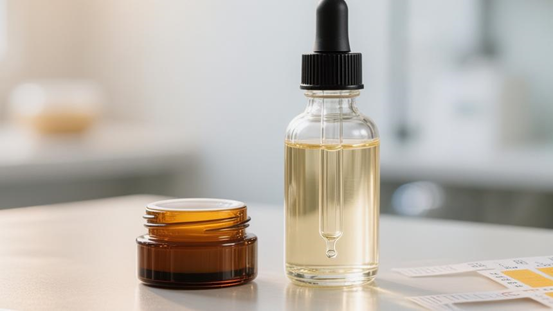
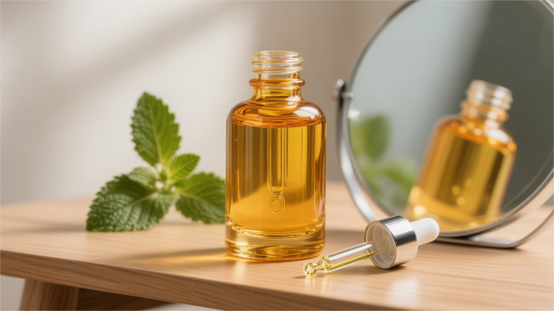
BioSyn-Bisabolol (α-bisabolol) is a 100% bio-based active ingredient with a purity of over 98% and a single levorotatory structure, exhibiting high stability and excellent penetration-enhancing effects in cosmetic formulations.
According to 3D skin model test data, the recommended formulation dosage is suggested to be 0.1% to 1.0%.
A low concentration of only 0.1% can significantly inhibit inflammatory factors such as IL-1α (inhibition rate as high as 72%).
Due to the use of advanced fermentation technology, no unstable oxide impurities are detected, making it not only mild and safe in various formulations such as serums, sunscreens, and baby care but also effective in promoting the transdermal absorption of other ingredients. It is an efficient choice for sensitive skin repair.
Formulation pH
BioSyn-Bisabolol (single levorotatory configuration with purity ≥ 98%) has a suitable formulation pH range of 3.0 to 9.0.
As it is produced via a 100% bio-based carbon fermentation process, no by-products such as Bisabolol Oxide A/B are detected.
This raw material does not undergo structural degradation in environments ranging from strong acid to slightly alkaline, nor does it cause a shift in the system's original pH value.
Formulators can add it directly to weak acidic creams (pH 4.5) or baby bath products (pH 7.0). It can also be added to AHA peeling formulas, but due to its penetration-enhancing effect, the dosage should be kept as low as possible.
Utilizing its non-ionic lipophilic properties, it should be added during the post-emulsification stage (< 50°C) to exert its effects on inhibiting specific substances such as IL-6, TNF-α, and cAMP.
In daily formulation development, the acid-base tolerance of a raw material directly determines which type of product line it can be incorporated into.
BioSyn-Bisabolol is a non-ionic sesquiterpene alcohol. The high-purity removal of common impurities found in chemical synthesis allows the raw material to maintain molecular structural integrity across a wide pH range.
Formulation developers do not need to modify the base pH of the system to accommodate this ingredient.
Formulation Performance
According to the regular pH standards of different end products, the performance and corresponding data of BioSyn-Bisabolol in formulations can be subdivided into the following common environments:
Formulation System pH Value | Common End Product Types | BioSyn-Bisabolol Performance and Data Support |
pH 3.0 - 4.0 | AHA/BHA exfoliants, high-concentration whitening serums | Remains stable without hydrolysis in low pH environments. Exerts a penetration-enhancing effect and works synergistically with acidic ingredients in skin brightening by reducing cellular cAMP production. |
pH 4.5 - 5.5 | Facial lotions, soothing creams, toners | Matches the normal pH of the human sebum film. In vitro tests show it functions normally for soothing under these conditions, specifically by inhibiting the release of pro-inflammatory mediators such as IL-6, TNF-α, and NO. |
pH 6.0 - 8.0 | Baby shampoos, body washes, surfactant-based cleansers | Maintains its original state in near-neutral to slightly alkaline surfactant-dominated systems without causing formulation discoloration, while providing auxiliary antibacterial effects against microorganisms such as Staphylococcus aureus. |
Precautions
Formulators need to pay attention to the following specific physical and chemical details when operating and adjusting pH.
Addition Process and Temperature Control
BioSyn-Bisabolol is a lipophilic liquid insoluble in water. When operating regular emulsification systems (such as O/W or W/O creams/lotions), it is recommended to add it during the cooling stage after emulsification is complete. When the temperature of the bulk drops to between 40°C to 50°C, slowly stir and mix it in with fragrances or preservatives. Avoiding the high-temperature homogenization stage protects the activity of its levorotatory configuration to the greatest extent.
Compatibility with pH Adjusters
Adding the raw material itself will not change the pH of the original aqueous phase or emulsification system. If citric acid (to acidify) or sodium hydroxide/arginine (to alkalinize) is needed in the final stage to set the product's pH, brief localized high concentrations will not cause bisabolol to deactivate or precipitate. Just ensure uniform stirring so the final pH of the overall system falls within the 3.0 to 9.0 range.
Solubilization Treatment for Transparent Aqueous Systems
To add BioSyn-Bisabolol to transparent toner or essence water systems around pH 5.0, since there is no oil phase in the system, a solubilizer (such as PEG-40 Hydrogenated Castor Oil or Polysorbate-20) must be used for pre-mixing. The pH of the pre-mixture is usually neutral. After adding it to the water phase, use regular pH adjusters to set the overall solution to the target pH to avoid turbidity or layering in the system.

Temperature
In formulation operations, (-)-α-bisabolol with purity ≥ 99% should be added when the emulsification system cools below 50°C-60°C to prevent volatilization and degradation caused by high temperatures.
The raw material's daily storage temperature is set at 15°C-25°C in a light-protected and dry environment.
At a human skin temperature of 36°C-37°C, it can improve the transdermal flux of water-soluble components;
Regarding UV-induced skin thermal stress erythema, at a 0.1% dosage, the inhibition rates for IL-1α, PGE2, and IL-6 are 72%, 62%, and 59%, respectively.
Formulation Temperature Control
α-bisabolol belongs to the class of sesquiterpene alcohols; prolonged exposure to high temperatures increases the probability of oxidation and volatilization.
For single (-)-α-bisabolol (BioSyn-Bisabolol) prepared by bio-fermentation technology with purity ≥ 99%, specific parameters define the heating and cooling procedures in formulations.
Addition Timing: Add during the cool-down phase of the emulsification system.
Temperature Definition: Mix into the formulation when the bulk temperature drops to between 50°C to 60°C, or lower.
Operating Standards: After adding, ensure uniform dispersion through regular stirring; do not add early during the high-temperature homogenization emulsification stage (typically 75°C-85°C).
Storage Temperature for Raw Materials and Finished Products
Temperature and ambient light can change the physicochemical state of naturally derived ingredients. Below are the storage parameter specifications:
Storage Condition Classification | Temperature and Environmental Requirements | Status and Impact Description |
Routine Storage | 15°C - 25°C | Maintains a transparent liquid state, keeping purity and activity stable |
Humidity and Light | Relative humidity < 60%, protect from light | Prevents photo-oxidation reactions and maintains the high purity indicator of ≥ 99% |
Packaging and Finished Products | Sealed opaque containers | If transparent packaging is used for the finished product, it must be labeled to be stored in a cool place |
Performance on Body Temperature and Thermal Stress
When the product is applied to the human body surface (normal body temperature range 36°C-37°C), (-)-α-bisabolol exhibits a penetration-enhancing effect.
It improves the transdermal flux of other ingredients in the formulation by altering the arrangement of lipids in the stratum corneum. Increased permeability data was recorded in combined tests with model drugs such as Propranolol HCl.
In response to skin localized temperature rise and inflammatory reactions caused by sun exposure (high temperature and UV exposure), a 3D in vitro epidermal model (EpiKutis®) provided quantitative data: 0.1% concentration of (-)-α-bisabolol reduces Interleukin-1α (IL-1α) by 72%, Prostaglandin E2 (PGE2) by 62%, and Interleukin-6 (IL-6) by 59% against UVB-induced inflammatory responses.

Recommended Dosage
Based on bio-fermented bisabolol with a single levorotatory configuration ((-)-α-Bisabolol) and purity > 99%, the recommended dosage range is 0.1%-1.0%.
In EpiKutis® 3D epidermal model tests, the inhibition peak is reached at a 0.1% dosage: inhibition rates for IL-1α, PGE2, and IL-6 reach 72%, 62%, and 59%, respectively.
Regular leave-on facial products can meet soothing and penetration-enhancing needs with 0.1%-0.2%; for sunscreens, after-sun, and infant/child products, it is recommended to increase to 0.3%-0.5%.
0.1% Concentration
In 3D in vitro epidermal model tests induced by ultraviolet (UVB), bisabolol samples of different concentrations were set up to detect their inhibition of various inflammatory indicators.
Test data proves that 0.1% is a cost-effective starting point for efficacy:
IL-1α Inhibition Rate: Reaches 72% at 0.1% concentration.
PGE2 Inhibition Rate: Reaches 62% at 0.1% concentration.
IL-6 Inhibition Rate: Reaches 59% at 0.1% concentration. In the comparison group, the inhibition rate for IL-6 in the 1 µg/ml dexamethasone positive control group was lower than this value; 0.1% bisabolol showed superior inhibition data.
Recommended Dosage and Application Directions
Different formulation types vary based on target skin conditions. According to the specific use of the product, the dosage can be adjusted in gradients between 0.1% and 0.5%.
Product Category | Recommended Dosage | Specific Application Directions and Data Reference |
Facial Leave-on
(Serums, creams, lotions) | 0.1% - 0.2% | Scavenges epidermal reactive oxygen species (ROS) and inhibits the release of pro-inflammatory pathways. In daily lotion/cream systems, a base dosage of 0.1% is sufficient to maintain skin barrier homeostasis and assist in reducing melanin deposition (cAMP pathway). |
Special Care
(Sunscreens, after-sun, baby products) | 0.3% - 0.5% | Responds to high-intensity UV stimulation. Higher concentrations can more quickly alleviate erythema caused by sun exposure and reduce potential irritation from sunscreens themselves and in thin-skin formulations for infants/children. |
Rinse-off and Local Care
(Facial cleansers, shampoos, lip balms) | 0.1% - 0.3% | Targets the scalp or lips. At this concentration, bisabolol has inhibitory effects on microorganisms such as Staphylococcus aureus, making it suitable for inclusion in cleanser systems to alleviate local epidermal inflammatory responses. |
Compound Penetration-Enhancing Compatibility
When establishing the dosage, the penetration-enhancing property of bisabolol is a reference indicator in formulation design. Due to its molecular structural characteristics, α-bisabolol can alter the arrangement of lipids in the stratum corneum.
In vitro transdermal diffusion data shows that adding bisabolol to formulations in conventional proportions can significantly improve the transdermal flux of substances such as 5-Fluorouracil and Triamcinolone Acetonide.
In complex formulations containing multiple plant extracts or oil-soluble ingredients, 0.1% to 0.2% bisabolol not only provides soothing data for the monomer itself but also acts as a natural transdermal enhancer, improving the absorption rate of other ingredients in the system and concurrently reducing epidermal water loss.