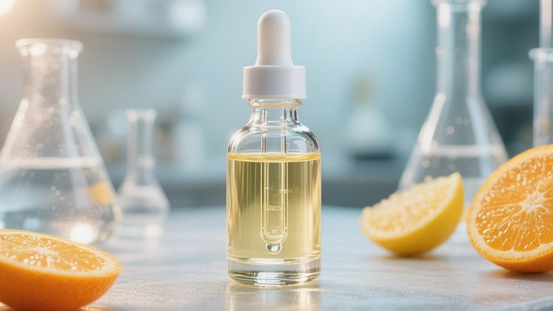
For a beginner-friendly introduction to Ethyl Ascorbic Acid (EAA), formulas containing 0.1% to 3.0% are ideal because this amphiphilic molecule, with a purity of >99.0% and 86.3% Vitamin C content, penetrates the skin barrier more efficiently than traditional derivatives.
Safety data confirms that EAA remains non-irritating even when tested at concentrations as high as 30% on reconstructed human epidermis, meaning a standard starter dose is exceptionally gentle within the stable pH range of 3.0 to 6.0.
Despite these lower percentages, the ingredient remains biologically active, capable of inhibiting tyrosinase and delivering a proven 54.68% increase in collagen synthesis without the risk of sensitivity.
Start Dose
Base Concentration
For first-time users, there is no need to look for high-concentration products of 10% or 15% as one would with L-Ascorbic Acid.
According to formulation guidelines, 0.1% to 3.0% is the standard recommended dosage for Ethyl Ascorbic Acid.
The reason it is effective at low concentrations is that Ethyl Ascorbic Acid changes the penetration logic of traditional Vitamin C. As an amphiphilic molecule, it is both hydrophilic and lipophilic.
This structural characteristic allows it to penetrate the sebum membrane on the skin surface and enter the stratum corneum more smoothly, where it is subsequently metabolized and reduced to pure Vitamin C by enzymes in the skin.
The actual utilization rate of 1% Ethyl Ascorbic Acid may be superior to high-concentration but low-permeability L-Ascorbic Acid.
Safety Limit and Tolerance
Below is a comparison of skin irritation test data conducted in the laboratory:
Test Item | Test Model | Concentration | Test Results | Conclusion |
Cytotoxicity Test | 3T3 Cells | 0.78 - 25 mg/mL | IC50 > 25 mg/mL | Extremely low cytotoxicity |
Irritation Test | RHE (Reconstructed Human Epidermis) | 30% Solution | Normal cell viability | Non-irritant |
Even when the concentration is increased to 30% (which far exceeds the 2%-3% typically used in daily skincare products), contact tests showed no destructive irritation to skin tissues.
For beginners, choosing a product with around 2% is actually operating within an extremely safe range, with an extremely low probability of intolerance.
pH Environment Impact
Another reference dimension for choosing the starting dose is the pH value. L-Ascorbic Acid usually requires a pH lower than 3.5 to maintain stability and penetrate the skin.
In contrast, Ethyl Ascorbic Acid is very stable, and its effective and stable pH range is between 3.0 to 6.0.
Gentle Zone: Most Ethyl Ascorbic Acid products are formulated at a pH of around 5.0, which is very close to the physiological pH of human skin.
Stability Data: Tested in a high-temperature environment of 45°C for 90 days, there was almost no change in color or active ingredient content.
Performance at Low Concentrations
At lower concentrations, Ethyl Ascorbic Acid has already demonstrated clear biological efficacy:
Collagen Synthesis: Experimental data shows that after treatment with a certain concentration of Ethyl Ascorbic Acid, the collagen synthesis rate increased by 54.68%.
Melanin Inhibition: It can directly bind to Cu2+ (copper ions), thereby inhibiting tyrosinase activity and blocking melanin production from the source.

Routine
3-O-Ethyl Ascorbic Acid (AC-VCE) is a molecule with an amphiphilic structure (hydrophilic and lipophilic), which allows it to penetrate the stratum corneum and reach the dermis with extremely high efficiency.
Laboratory data show that AC-VCE maintains its high activity in an environment of pH 5.0-6.0 and shows no significant oxidative discoloration after 90 days at 45°C.
Morning use can utilize its ability to scavenge free radicals to assist in sun protection, while evening use mainly plays the roles of inhibiting tyrosinase activity (whitening) and promoting collagen synthesis; it is generally well tolerated and does not require a separate buildup phase.
Morning Routine
Due to its good photostability, AC-VCE is less prone to decomposition and maintains efficacy more effectively than L-Ascorbic Acid when exposed to light.
Use directly after cleansing
Data indicates that AC-VCE is a small molecular weight ethyl ether derivative. Compared to ordinary water-soluble ingredients, its lipophilic end helps the molecule pass through the sebum membrane faster. Applying it to freshly cleansed, dry skin helps maximize absorption of the active ingredient.
Assisting Sunscreen
Sunscreen can only block UV rays, but cannot handle the reactive oxygen species (ROS) produced by UV rays that "slip through the cracks" into the skin. AC-VCE can effectively scavenge these free radicals and help reduce inflammation triggered by UVB.
Operation Suggestion: Apply a layer of AC-VCE essence before applying sunscreen, which is equivalent to adding a filter against free radicals to the skin.
Evening Routine
At night, the skin is in repair mode and free from UV interference, making it the best time for AC-VCE to exert its biological activities.
Inhibiting Melanin Production
AC-VCE inhibits tyrosinase activity by binding to copper ions. According to in vitro test data, the inhibition rate of a certain concentration of AC-VCE on tyrosinase activity can exceed 96%. Continuous use at night can reduce melanin synthesis from the source.
Promoting Collagen Synthesis
After penetrating the skin, AC-VCE is metabolized into ascorbic acid, participating in the collagen synthesis process. Studies have shown that it can help improve skin structure and elasticity with continued use.
Pairing and Operational Details
To better understand the convenience of AC-VCE in the routine, we can compare it with traditional L-Ascorbic Acid (L-AA):
Dimension | L-Ascorbic Acid (L-AA) | Ethyl Ascorbic Acid (AC-VCE) | Impact on Routine |
Optimal pH | Below pH 3.5 | pH 5.0 - 6.0 | AC-VCE is close to human skin pH; no need to wait for pH recovery before subsequent steps. |
Penetration | Water-soluble only, difficult penetration | Hydrophilic + Lipophilic | AC-VCE absorbs faster without needing strong acids to exfoliate for penetration. |
Irritation | Prone to stinging/redness | Gentle (Confirmed by RHE test) | Sensitive skin usually does not need a tolerance period and can be used daily. |
Compatibility | Hard to coexist with Niacinamide/Retinol | High Compatibility | At pH 5-6, it can be safely used with moisturizers, Retinol, or Niacinamide. |
Storage and Stability Instructions
Heat Resistance Data: After 90 days in a constant temperature incubator at 45°C, the AC-VCE content remained above 95% and the product showed no significant color change.
Daily Storage: Store at room temperature, such as in a bathroom cabinet or on a dressing table. Avoid direct sunlight on the bottle. Although AC-VCE is photostable, minimizing light exposure helps maintain its stability and activity.

Timeline
Phase 1: 0 to 24 Hours
On the first day after application, although changes in skin tone cannot be observed immediately with the naked eye, biochemical processes at the microscopic level have already begun. The amphiphilic structure of AC-VCE allows it to penetrate the stratum corneum barrier, enter the dermis, and metabolize into ascorbic acid.
During this period, two specific quantitative indicators are worth noting:
Free Radical Scavenging: Oxidation is the main cause of skin dullness and damage. According to DPPH free radical scavenging experiments, AC-VCE at a concentration of 0.1 g/L achieved a scavenging rate of over 70% within 30 minutes of contact. This suggests that after morning application, the ingredient has already established an antioxidant protective net before you head out.
Collagen Synthesis: In vitro tests show that human dermal fibroblasts, after 24 hours of treatment with AC-VCE, reached collagen synthesis levels over 10 times that of the control group. This synthesis is the foundation of skin firmness; though it occurs at the microscopic level, the startup speed is extremely fast.
Phase 2: 1 to 4 Weeks
In stability tests regarding shelf life, AC-VCE solution (pH 5.5) was kept in an extreme high-temperature environment of 50°C for 30 days; its appearance remained colorless, and no decomposition was detected.
For users, this means that within the first month after opening, the concentration of the ingredient applied to the face daily remains consistent with the first day, with no decay.
Since AC-VCE is suitable for formulation pH values of 4.0 - 6.0, which is close to the physiological pH of human skin, first-time users rarely experience stinging or peeling in the first few weeks, allowing them to maintain daily use and ensure sufficient cumulative dosage.
Phase 3: 4 to 12 Weeks
As the stratum corneum turnover occurs, the biological effects accumulated in the earlier stages begin to become visible. The results in this phase primarily stem from the efficient inhibition of tyrosinase by AC-VCE.
Tyrosinase is the rate-limiting enzyme in melanin production; inhibiting its activity can help reduce the appearance of spots and dullness.
The table below shows the comparison of tyrosinase inhibition rates between AC-VCE and other common ingredients (under the same test conditions):
Ingredient Name | Tyrosinase Inhibition Rate | Data Interpretation |
AC-VCE | 80.8% | Significantly higher than L-Ascorbic Acid, close to that of the potent whitening agent kojic acid. |
Kojic Acid | 95.5% | Traditional potent whitening benchmark, but with higher irritation. |
L-Ascorbic Acid | 68.5% | Effective, but the inhibition rate is approximately 12 percentage points lower than AC-VCE. |
Arbutin | -- (Lower than AC-VCE) | Effect is weaker than AC-VCE under the same experimental conditions. |
In this phase, an inhibition rate of 80.8% means the source of melanin production is significantly cut off. Combined with the cumulative effect of collagen synthesis from earlier stages, the smoothness and translucency (radiance) of the skin will show improvements supported by data.